
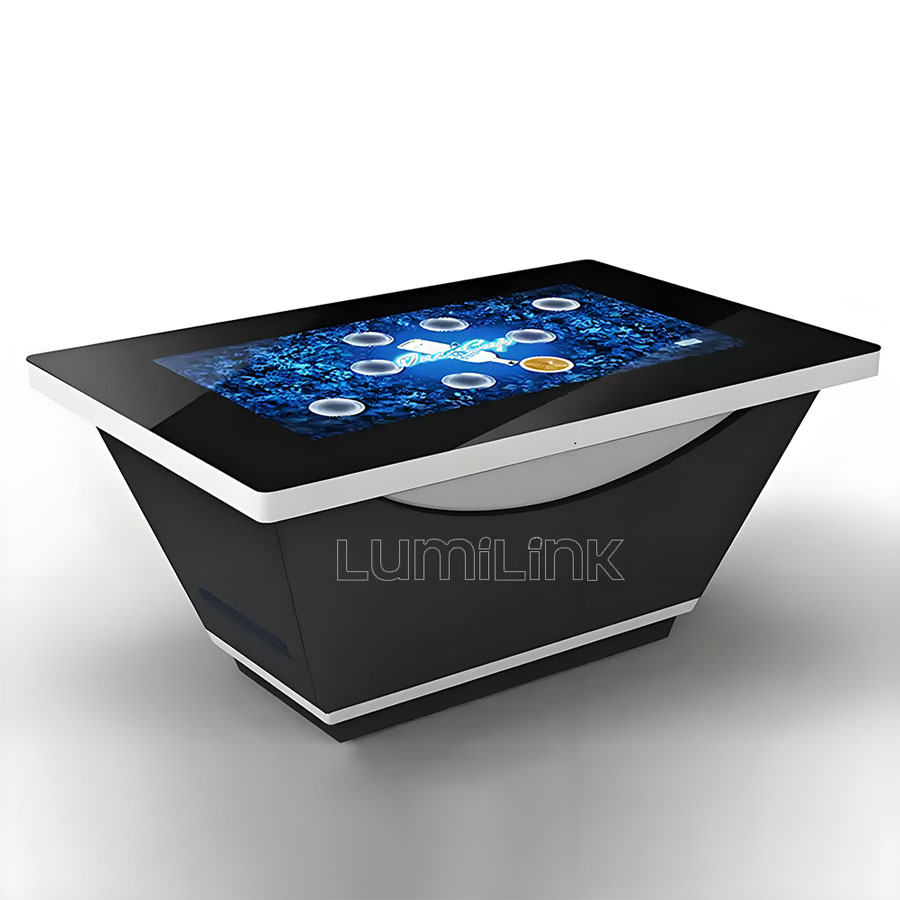
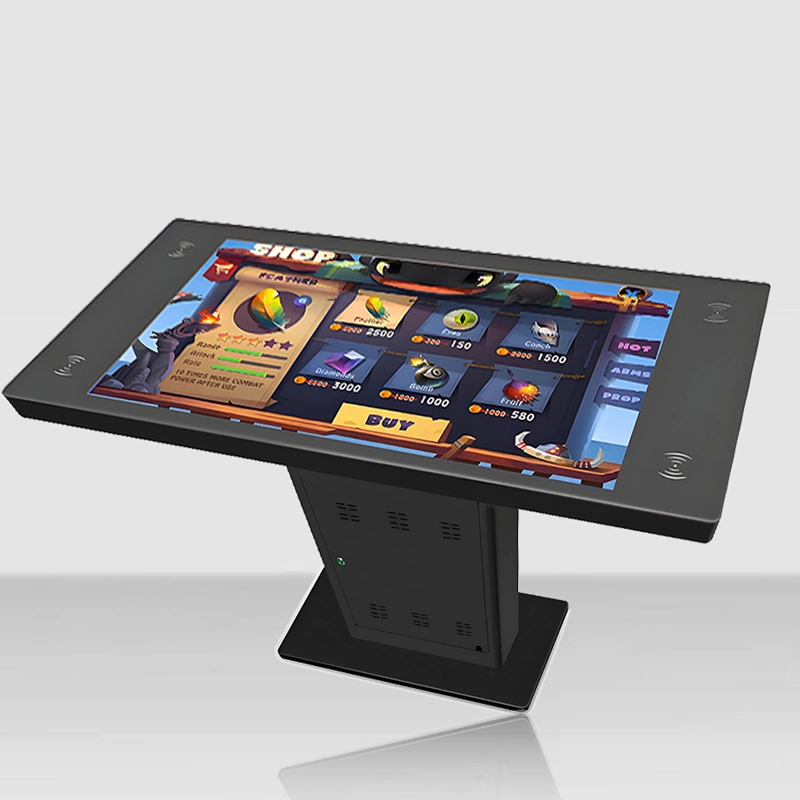
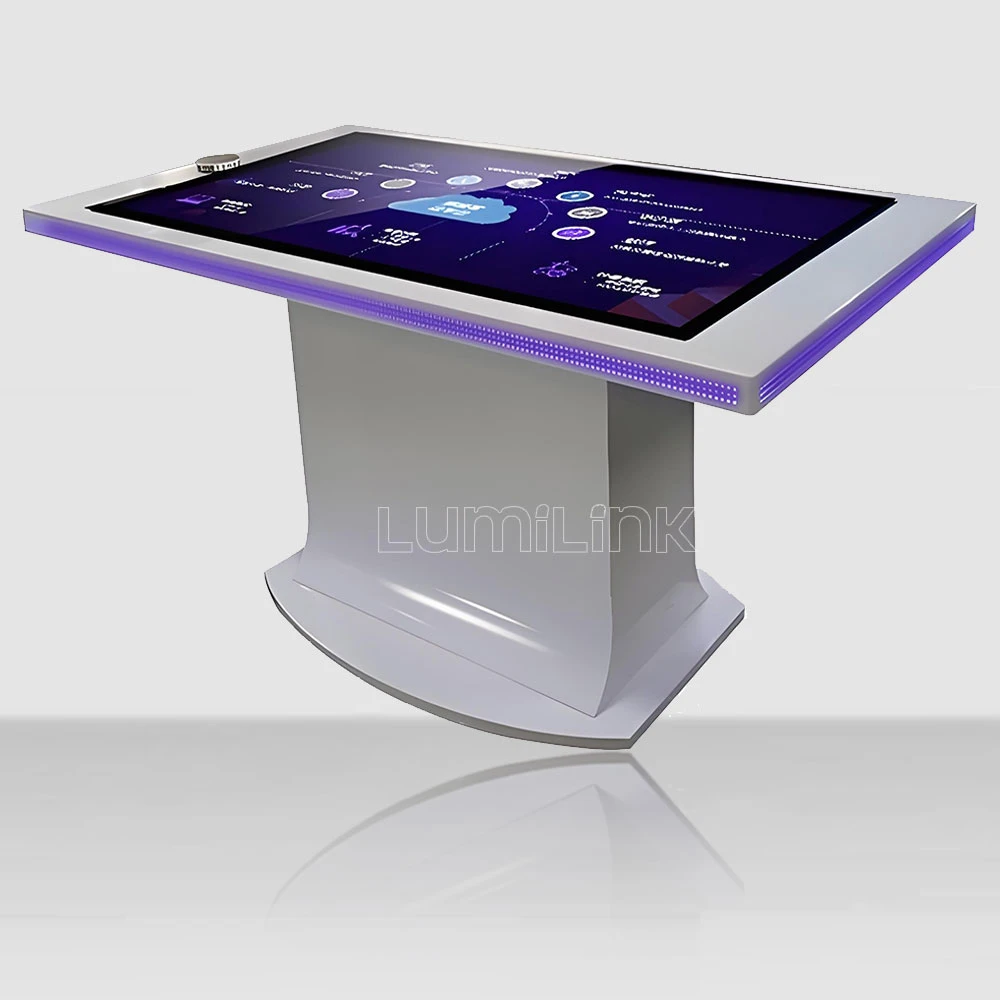

In 2026, businesses across every sector are rethinking how they engage audiences in physical spaces. When the engagement has to work for a crowd rather than a pair, the format that keeps coming back is the large touch screen table — horizontal surfaces from 65 inches up to 86 inches and beyond, built so that four to eight people can gather, reach the middle and interact at once. Keyword data shows steady commercial demand for the phrase, with advertisers bidding actively on it — a signal that buyers here are comparing real purchases, not browsing a trend.
Large-format tables sit at the top of the interactive table category for a reason: past 65 inches, panel sourcing, glass handling, structural engineering and freight all step up in difficulty. That is exactly why the buying decision rewards preparation — the spread between a well-specified unit and a poorly specified one is wider at this size than anywhere else in the category.
This guide maps the decision: when a large table beats multiple smaller ones, what the engineering looks like at scale, what the format costs, and the checklist to run before ordering.
When a Large Touch Screen Table Beats Two Smaller Ones
The case for going large is about the shape of the content and the shape of the crowd. A 55-inch table serves four people well; add a fifth and sixth and the edges become the only usable territory, because nobody reaches the middle. Content with a wide canvas — a city masterplan, a project timeline, a shared map, a configurator a salesperson walks two clients through — wants one unbroken surface more than it wants two divided ones.
There is a floor-space argument too. One 86-inch table occupies roughly the footprint of one mid-size table, while the alternative — two 55-inch units side by side — doubles the footprint, doubles the cabling, doubles the media players and splits any shared content across a gap. For exhibition stands, museum galleries and showrooms where square meters carry real rent, the single large surface is frequently the denser use of space.
And there is a social-physics argument. People cluster around a large shared surface differently than they distribute across two small ones: conversations form, strangers lean in, groups negotiate turns. Exhibition teams report that one big table holds a crowd longer than a row of small ones precisely because the crowd can see what everyone else is doing. That visibility is a feature, and it only exists on one plane.
The counter-case is worth stating honestly: if the content is single-user (a menu, a catalog) and the crowd is small, a large table is wasted reach. Buy large when the content is shared and the audience is many; buy small when it is neither.
Key Specifications: the Engineering Past 65 Inches
Panel and resolution. 4K (3840 × 2160) is the sensible floor from 65 inches upward: at typical standing distances the pixels disappear, and the quadrants that four to six users naturally divide into each keep a usable share of resolution. Large panels below 4K are a content problem waiting to happen — every upscaled image is magnified across more inches.
Touch layer at scale. Projected capacitive is the standard: it senses through tempered glass, ignores the hall lighting, and survives public use with no exposed parts. The specification that matters most is the controller's tested simultaneous points — six adults exploring a map reach twelve-plus contacts at peak moments, and a controller that merges or drops touches will feel broken no matter what the panel brochure claims. Ask for the tested point count at the actual surface size, demonstrated with hands on the glass if possible.
Flatness and structure. Touch accuracy follows flatness, and glass at this size wants to bow under its own weight. A proper large table uses thicker tempered glass — 6 mm or more — a welded or machined chassis with cross-bracing, and a surface that stays flat within a couple of millimeters edge to edge. Rounded, polished edges are a safety requirement when eight people circle a surface all day.
Brightness. A horizontal surface collects every luminaire in the room, and lobbies and exhibition halls are bright places. Plan for 450 to 700 nits depending on venue lighting; below 350 nits is indoor-dim-only. An anti-glare glass treatment earns its premium at this size, where reflections land in multiple sightlines at once.
Compute and the signal chain. 4K content must survive the whole path: a media player or PC with true 4K output, cabling rated for the bandwidth, and a panel that accepts native 4K rather than upscaling. Confirm the chain in writing, including what happens when the source device is replaced in year three — the most common way a good table becomes a bad one.
Weight, freight and installation. Expect several hundred kilograms packed. Plan the route before ordering: doorway widths, floor loading, elevator capacity, and a crew experienced with panel handling. Installation is a two-to-four-person job with lifting equipment, not an unwrap-and-plug; a site survey in writing is the cheapest insurance in this purchase.
| Criteria | Projected Capacitive (PCAP) | Infrared (IR) Frame |
|---|---|---|
| Touch response through glass | Direct, no air gap if optically bonded | Floats above the glass surface |
| Light interference | Unaffected by sunlight or venue lighting | Strong direct light can cause false points |
| Edge-to-edge glass | Yes, flush glass surface | Visible bezel housing emitters |
| Spill and cleaning tolerance | Sealed, wipe-clean, no exposed sensors | Emitter strip needs periodic cleaning |
| Best fit | Restaurants, game cafes, bars, high-traffic halls | Budget projects, temporary installations |
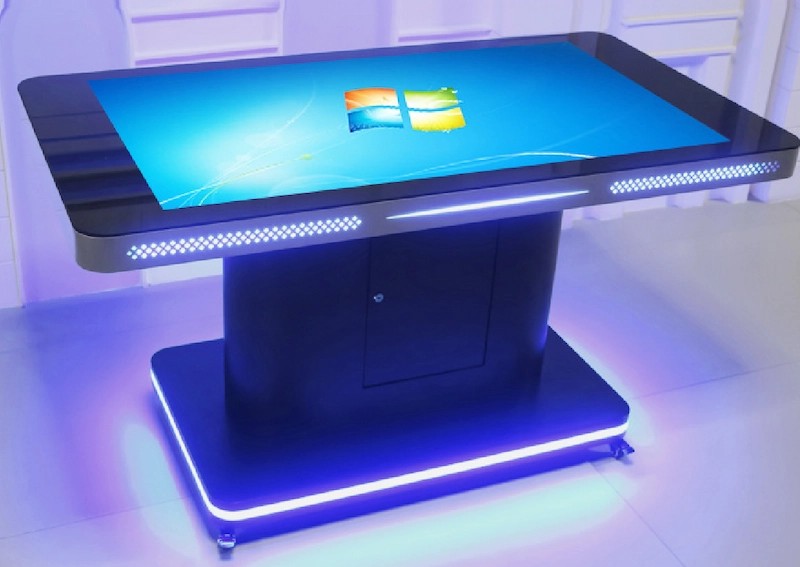
What an Oversized Touch Table Costs
Pricing is quote-based, and public records fill in the shape of the market. US federal procurement awards have documented 55-inch PCAP tables at roughly $37,000 and single multi-touch table awards above $80,000, with a dual-panel giant format plus wall bundle crossing $129,000 — figures that include configuration, delivery and support, so they read as all-in project costs rather than hardware list prices. Retail listings from earlier product generations put mid-size premium-brand tables in the $25,000-to-$35,000 band.
The pattern: premium-brand large formats live in the high tens of thousands to six figures once integrated. Factory-direct manufacturing changes the structure, not the physics — the panel, controller, glass and steel cost what they cost anywhere, but the distribution layers and brand premium come out of the middle. For multi-unit or fleet purchases the difference compounds, and it is the reason procurement teams increasingly run the comparison line by line rather than by brand familiarity. Quotes dramatically below realistic component cost are the mirror-image warning: something was removed from inside the frame, and the checklist below exists to find it.
Top Benefits of Going Large
True multi-user capacity. Four to eight people interact simultaneously on one surface — the group engagement that no wall display achieves, because wall displays have a back row.
One content canvas. Shared maps, timelines and configurators stay whole; no splitting content across two screens with a dead zone between them.
Space density. One large table replaces multiple small units and their duplicated hardware in roughly the same footprint — a meaningful number wherever floor space carries rent.
Presence. A large table anchors a room the way a campfire does: it defines where the gathering happens, which is worth as much in a showroom as in a museum.
Longevity of relevance. Content changes; the surface stays. A well-built large table outlives several generations of the software that runs on it, which is why the build specification matters more at this size, not less.
Real-World Use Cases
Museum centerpiece exhibits. Artifact explorers and historical timelines where a school group of thirty funnels into six or eight active users. Capacity is the exhibit design.
Real estate and urban planning. Masterplans and phased developments are wide content by nature; six stakeholders around one shared surface replaces the projector-and-wall ritual entirely.
Command and operations centers. Map-based monitoring wants width; a large horizontal surface becomes the shared situation table that wall screens cannot match for standing group work.
Trade show anchors. A large table is a booth design decision as much as a hardware one: it gives the sales team a stage, keeps crowds out of the aisles, and survives a thousand hands a day.
Automotive and flagship showrooms. A configurator on a shared surface puts the salesperson and the customer on the same side of the decision — trim, color, finance explored together, which is the collaborative motion large surfaces enable and vertical screens do not.
How to Choose the Right Large Touch Screen Table
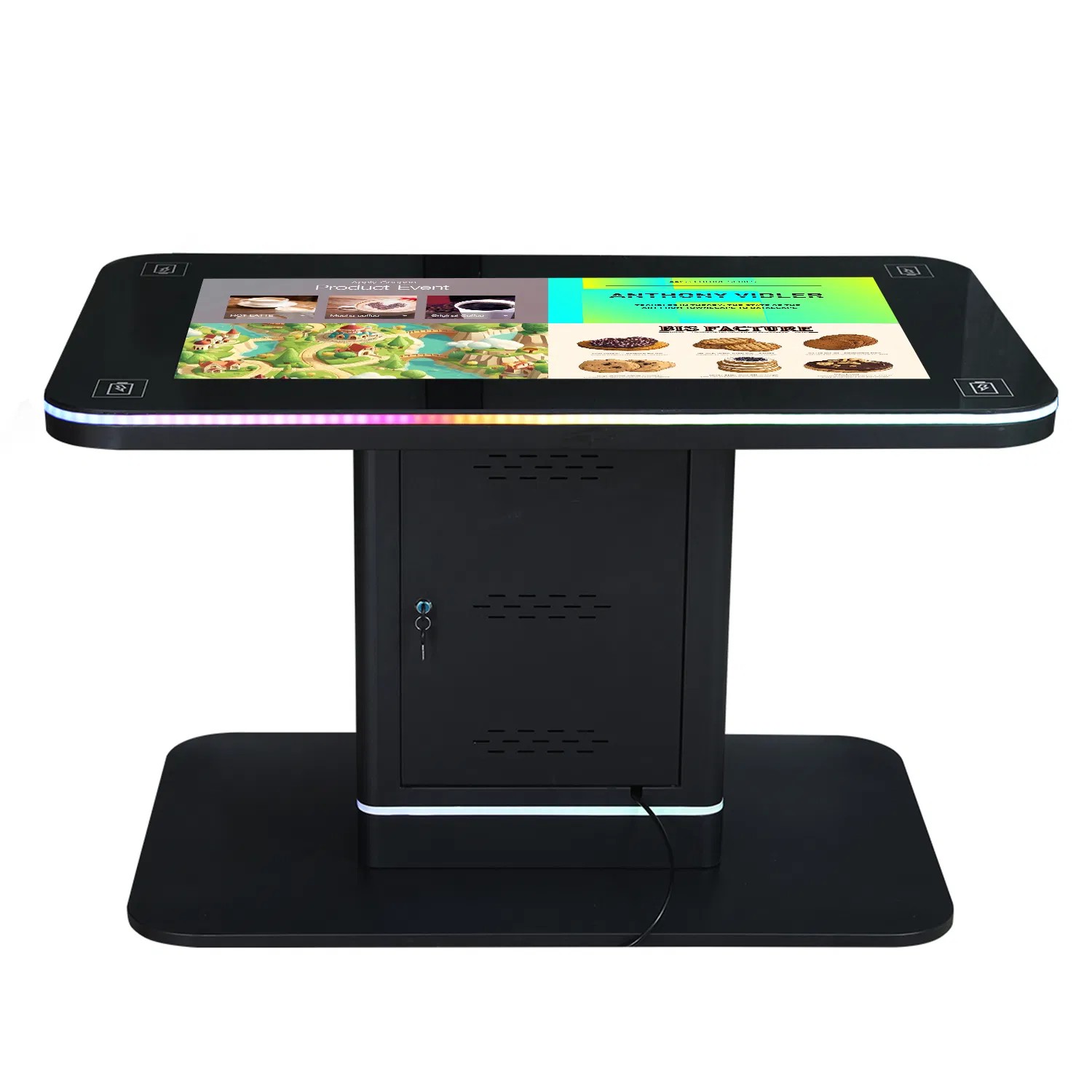
Run the checklist in order. One: confirm the use case is genuinely shared and multi-user — the honest gate for the format. Two: touch system — PCAP with a named controller, tested points at the size, and a demonstration in venue-like lighting. Three: structure — glass thickness, chassis bracing, stated flatness tolerance. Four: logistics — packed weight, crate dimensions, route survey, installation crew. Five: terms — warranty including freight on parts, controller spares availability, and a production schedule with dates.
Then apply the same five questions to both the premium-brand quote and the factory-direct one. The premium option buys proven integration and regional support; a direct manufacturer buys schedule control and a different price structure on multi-unit orders. Both can be the right answer — the checklist decides which one is right for your venue. Before either, commission a written site survey: delivery route, floor loading, power, ambient light, and the ceiling sightlines a horizontal surface will reflect. Large tables fail in installation more often than in electronics, and every one of those failure modes is visible on a survey sheet.
Why Lumilink Is the Right Partner
Lumilink builds interactive touch tables from 32 to 86 inches with PCAP touch, commercial-grade 4K panels, tempered safety glass and welded steel chassis, shipping factory-direct to more than fifty countries. Large formats are a customization workflow for us — size, enclosure finish, brightness and OS image are production configuration items — and multi-unit projects get a written schedule with named components.
Museums, exhibition halls, planning studios and showrooms run our tables daily, and we are comfortable being compared specification by specification: panel grade, controller model, flatness tolerance, terms.
Conclusion: Take the Next Step
A large touch screen table is the most demanding purchase in the category and the most rewarding when the use case is genuinely shared: one surface, many users, content that stays whole. Specify it with the same checklist you would apply anywhere else — documented components, a written schedule, a price you can trace to engineering — and it anchors a space for a decade.
Sizing a large-format installation? Request a Custom Quote today to receive a tailored proposal including hardware specifications, pricing, and implementation timeline. Or Download Product Spec Sheet to review detailed technical documentation for our full interactive touch table lineup.