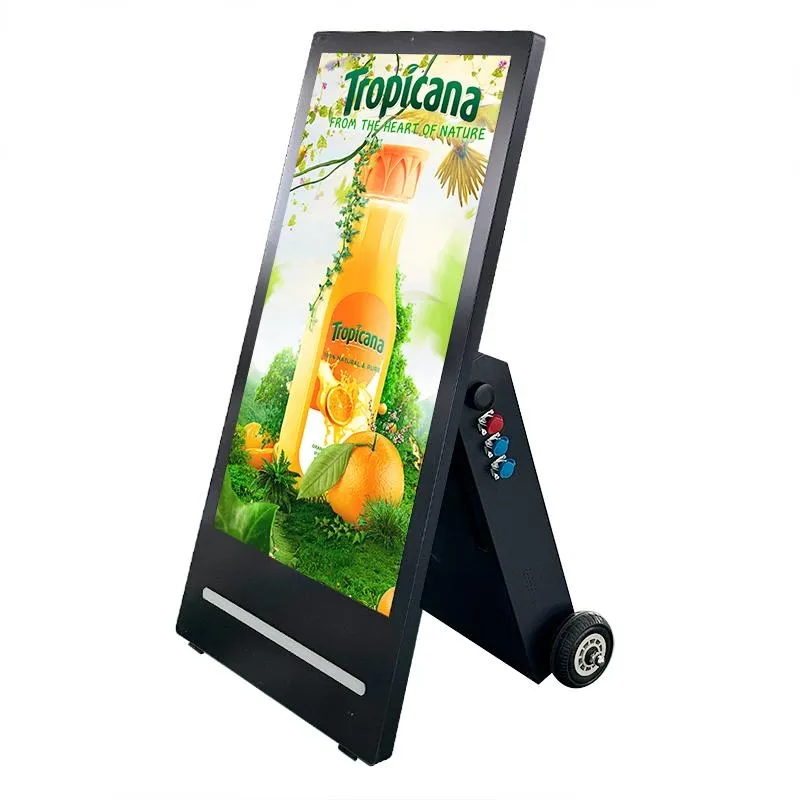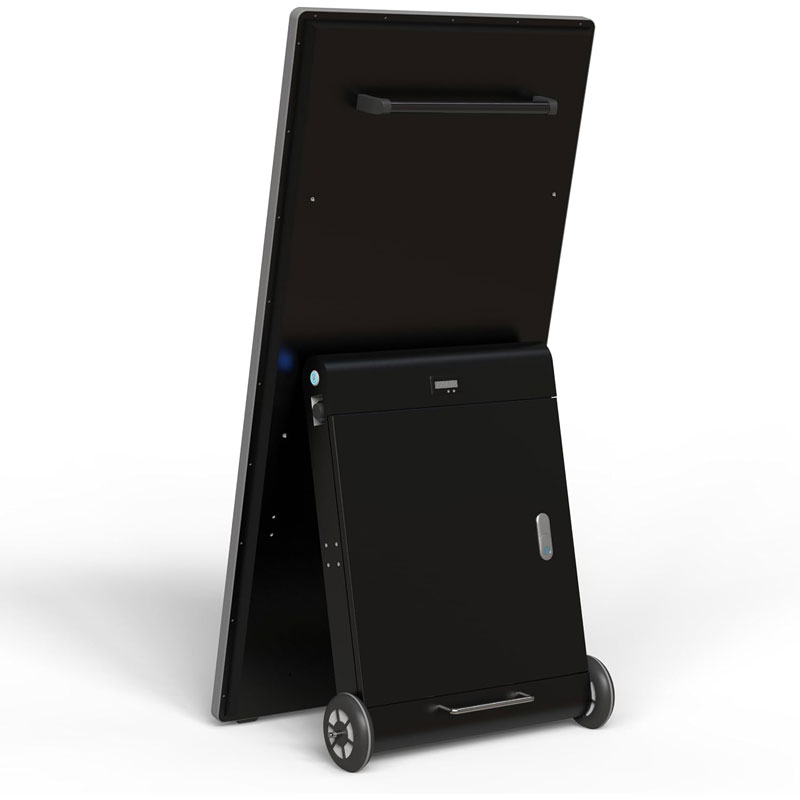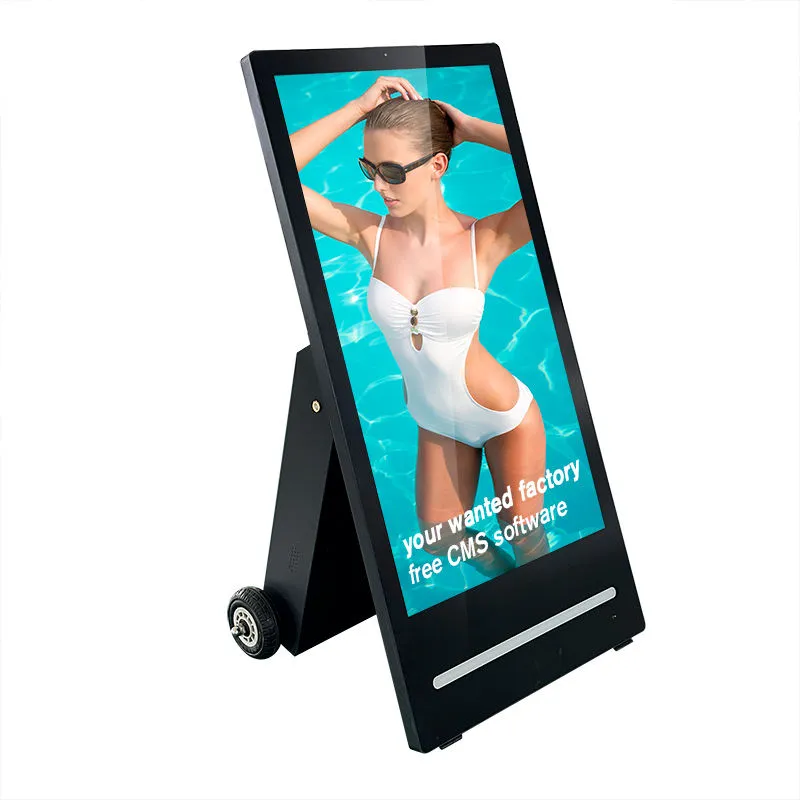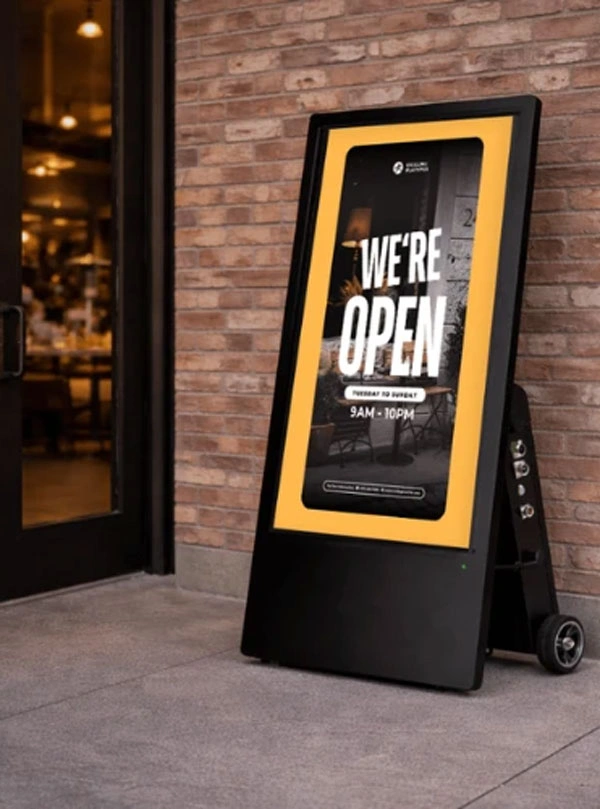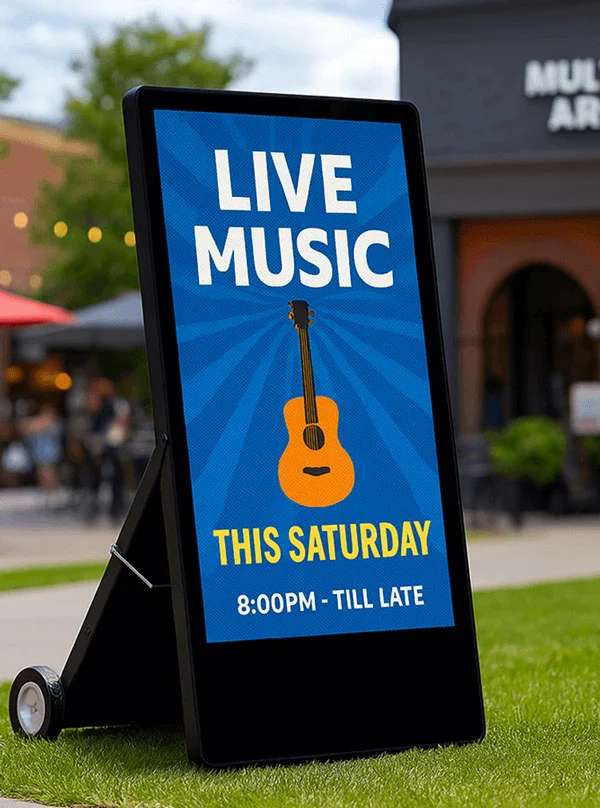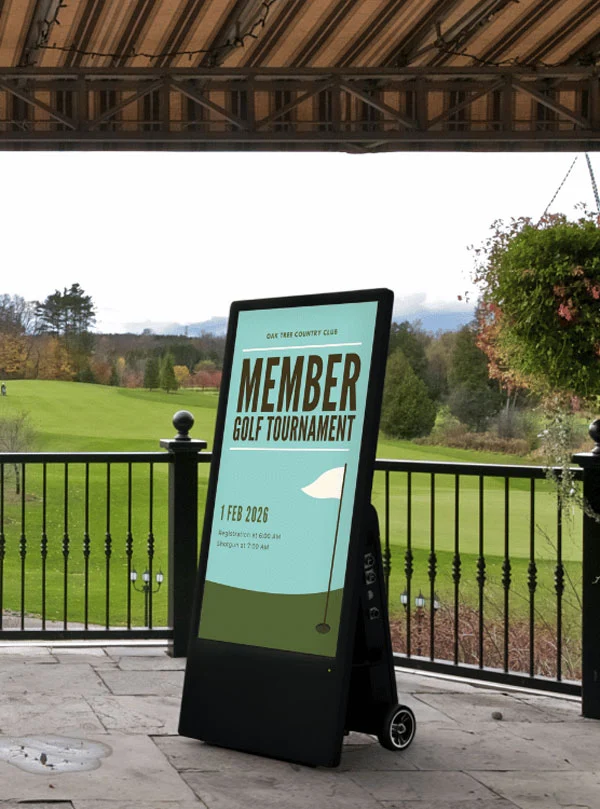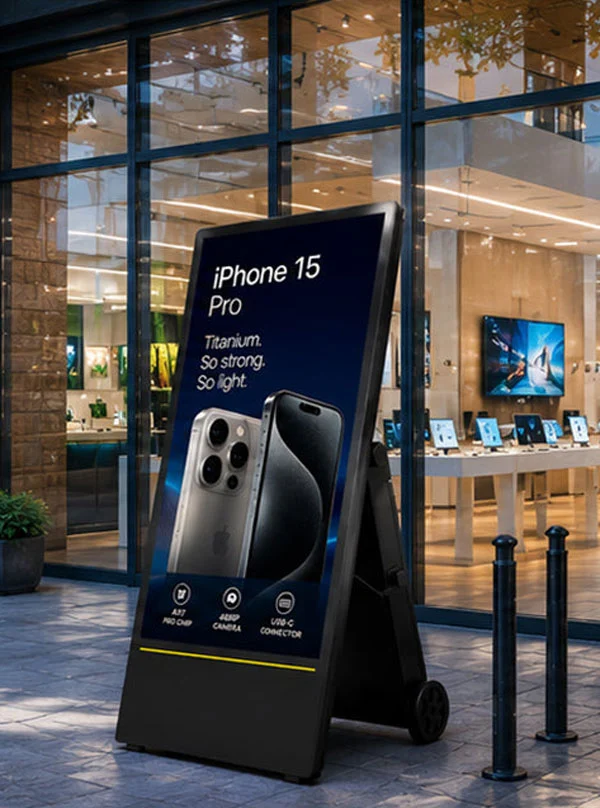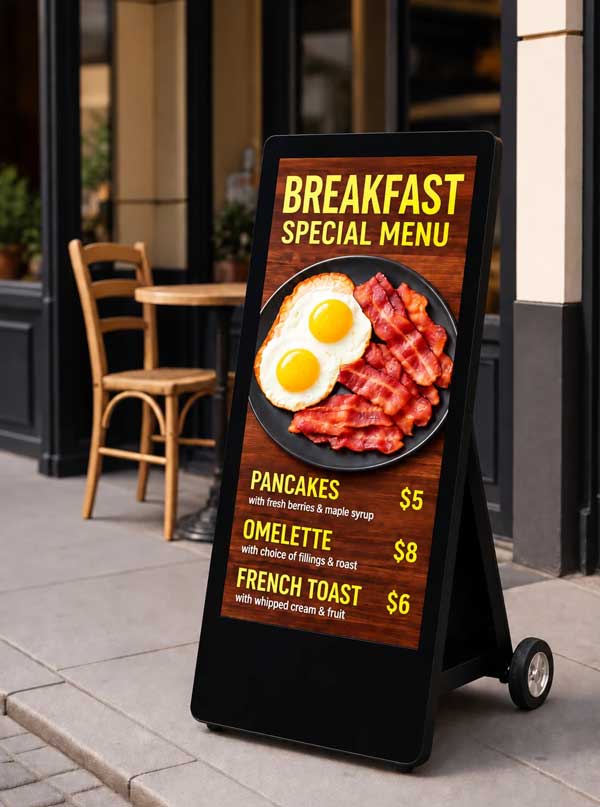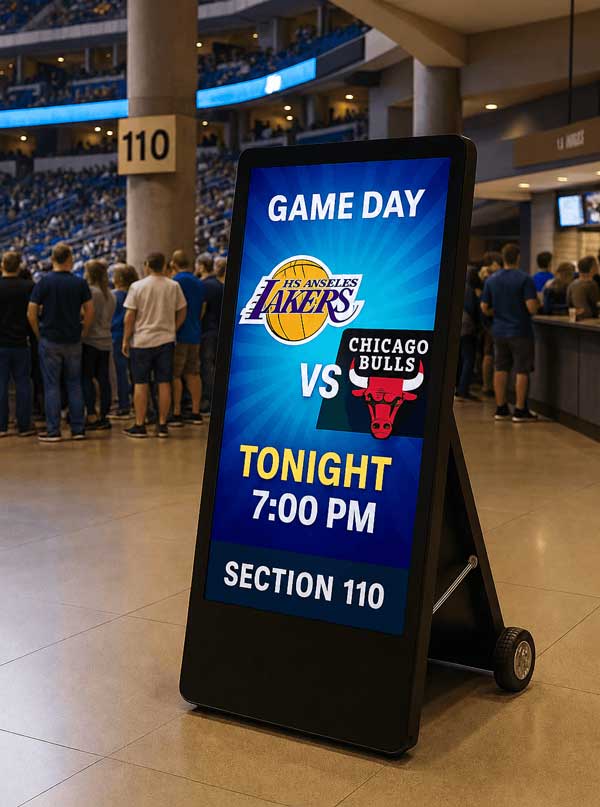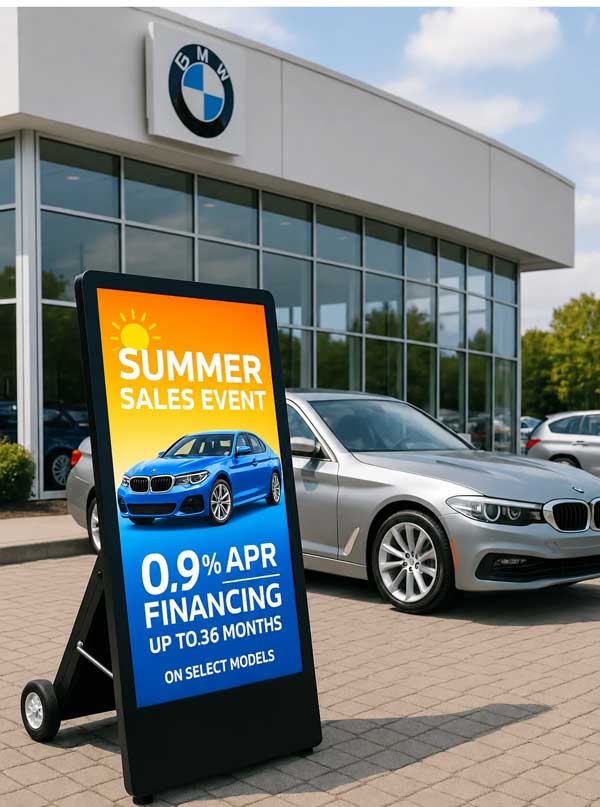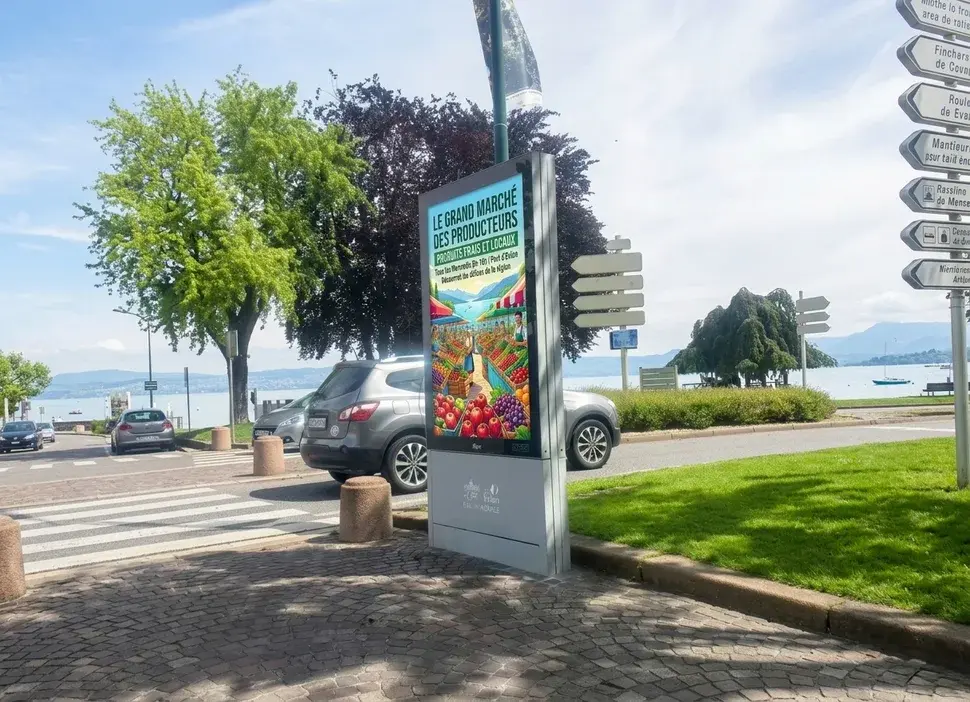
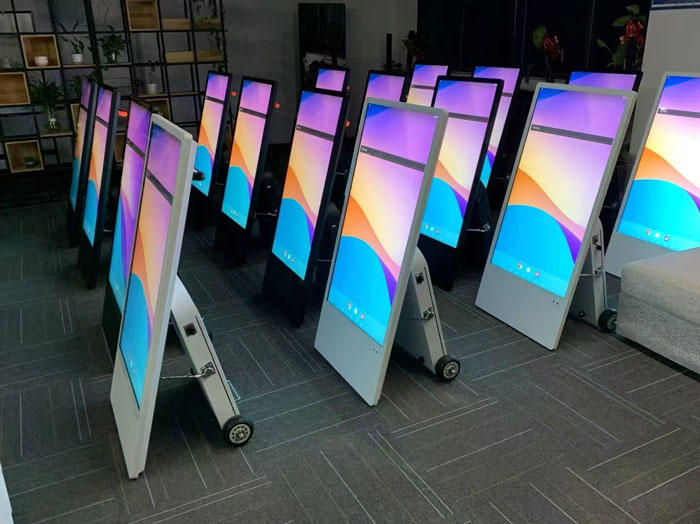
A digital poster on wheels is bought for one reason: it goes where the crowd is, without being lifted. LumiLink builds a wheeled portrait screen with two solid rubber wheels, a top carry handle and a bottom lift handle, so one operator can roll a 35, 40 or 65 kg unit from storage to kerbside in under a minute. The 14-hour battery, 1,800-2,000 cd/m2 sunlight-readable panel and IP65 cabinet do the rest - no power outlet, no installation, no vehicle.
The difference between a wheeled digital poster and every other portable display is not the screen - it is who does the carrying. An A-frame board is lifted into position and lifted back in at closing. A foldable poster is packed into a case and driven to the next venue. A digital poster on wheels is simply pushed, by one person, using a handle, with both feet on the ground.
That single mechanical difference changes three things about how the screen earns money. First, position becomes an hourly decision rather than a daily one: the same unit can hold a station entrance at breakfast, a food court at lunchtime and an event gate in the evening, because repositioning costs one minute rather than a vehicle trip. Second, the crew requirement drops: there is no lifting step, so the person running the shop can redeploy the screen between customers without help. Third, the storage question softens - a wheeled unit rolls into a back room, a corridor or a lock-up, and needs no carrying case.
The cost of this convenience is honest and specific: a wheeled chassis is the heaviest format in the portable family. LumiLink builds it in 35, 40 and 65 kg versions (32, 43 and 55-inch screens) and every one of them should be rolled, never carried far. This page explains the wheel system, the handling envelope and the stability question in the detail a buyer needs before choosing the wheeled format over a lighter one. Readers who need transport rather than mobility should start with the foldable poster display instead.


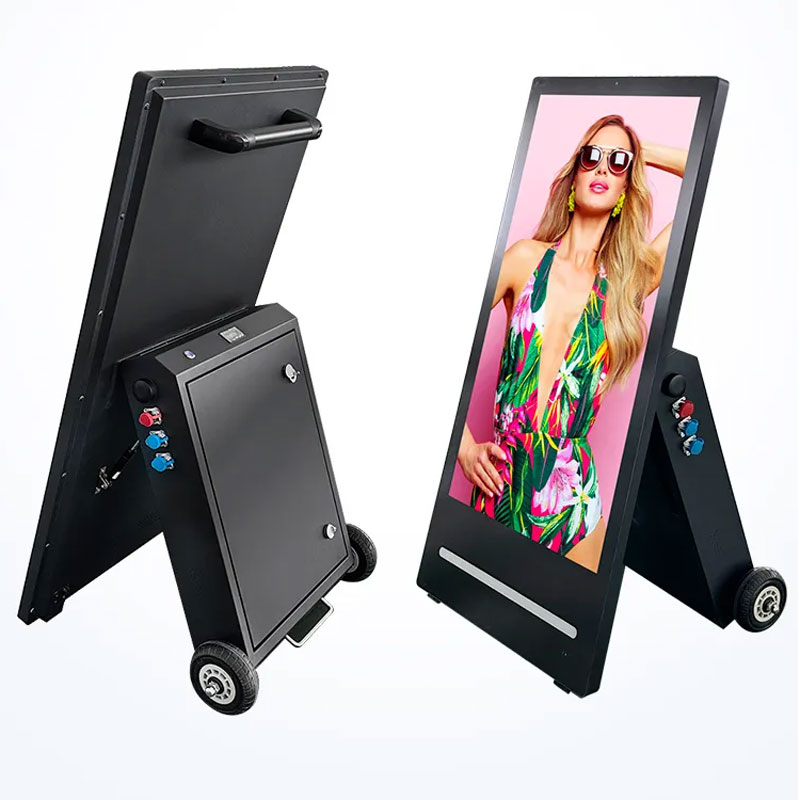
The mobility hardware on a wheeled digital poster is deliberately simple, because simple mechanisms survive outdoor use.
Two solid rubber wheels. Solid rubber is chosen over pneumatic or foam-filled tyres for one reason: it cannot puncture and does not need pressure maintenance over a multi-year service life. The wheel diameter is sized to clear the small obstacles of real pavements - expansion joints, drainage grates and the lip of a shop threshold - without a jolt that would disturb the screen or the battery connections.
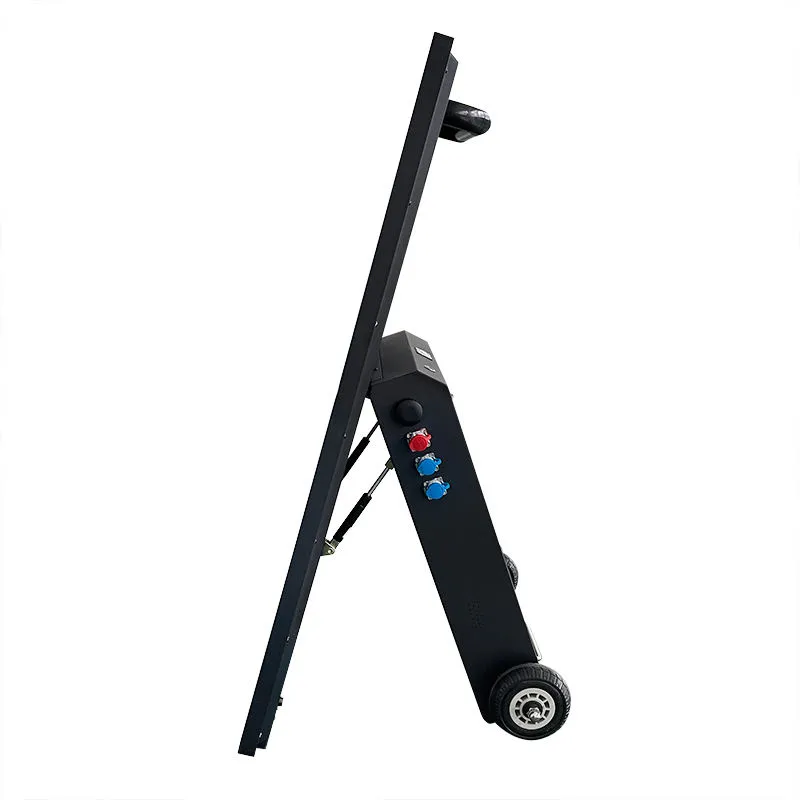
A rear-mounted chassis. The wheels sit behind the cabinet rather than under it. When the unit is stood upright the wheelbase is out of the way and the cabinet rests on its own base; when the unit is tilted back on the wheels, the chassis becomes the load path. This is the same geometry as a hand truck, and it is why a 65 kg unit rolls on two wheels rather than needing four.
Two grip points: a top carry handle and a bottom lift handle. The top handle spans the back panel at shoulder height and is the primary rolling grip. The bottom lift handle sits at the base and is used with the top handle when the unit has to be stepped over a kerb or lifted into a vehicle - two hands, two heights, one controlled movement.
Weatherproof charge ports. The red and blue sealed connectors on the cabinet side double as the charging inlet and accessory power, with weatherproof caps so the ports can be closed against rain when the unit is deployed.
LumiLink foldable poster displays fo...
More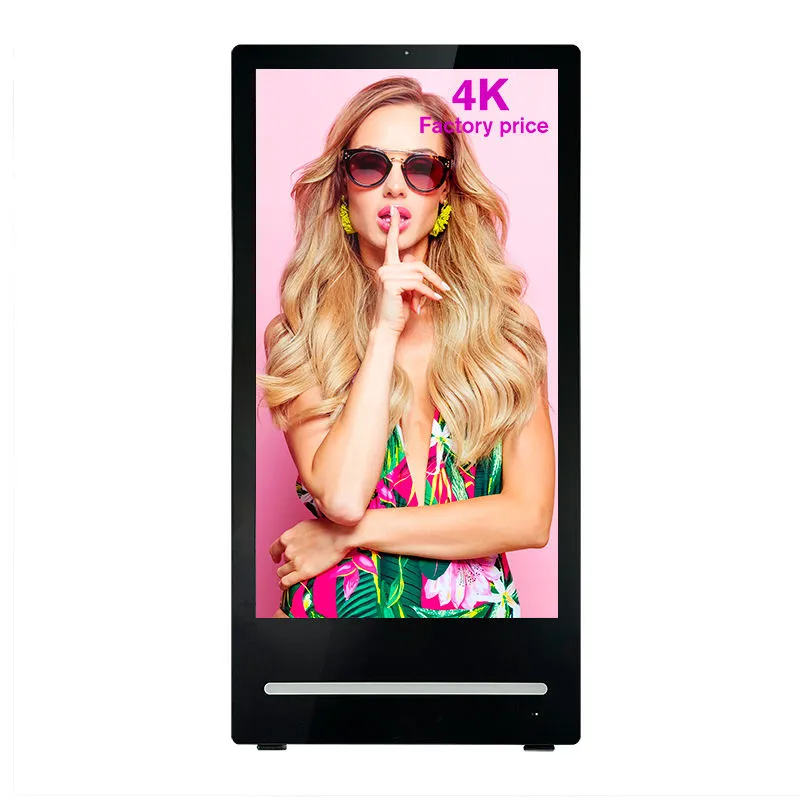
LumiLink A-frame digital boards mode...
More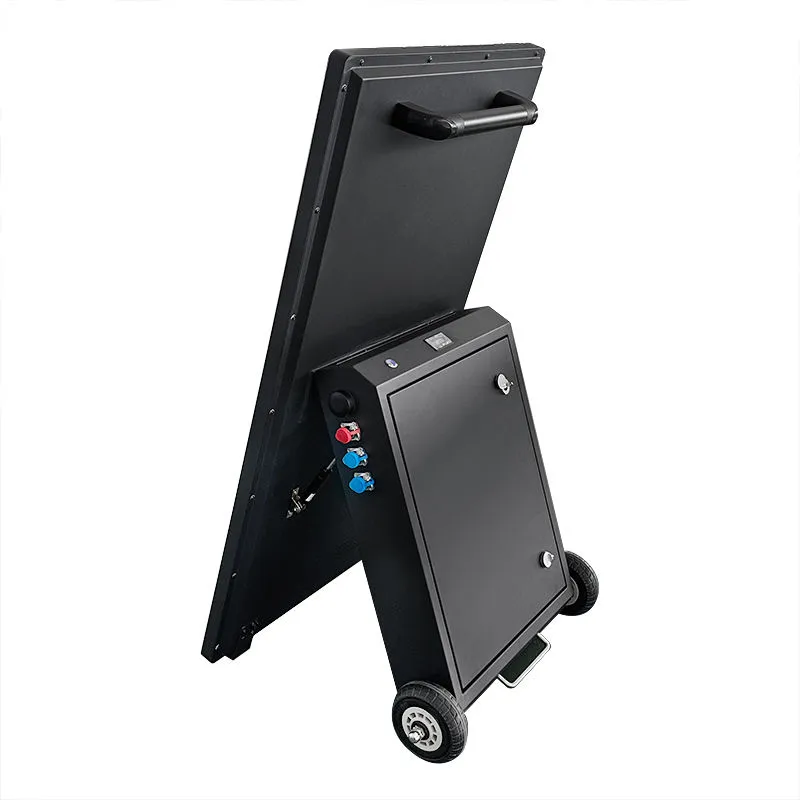
Battery powered digital signage with...
MorePortable outdoor digital signage in ...
More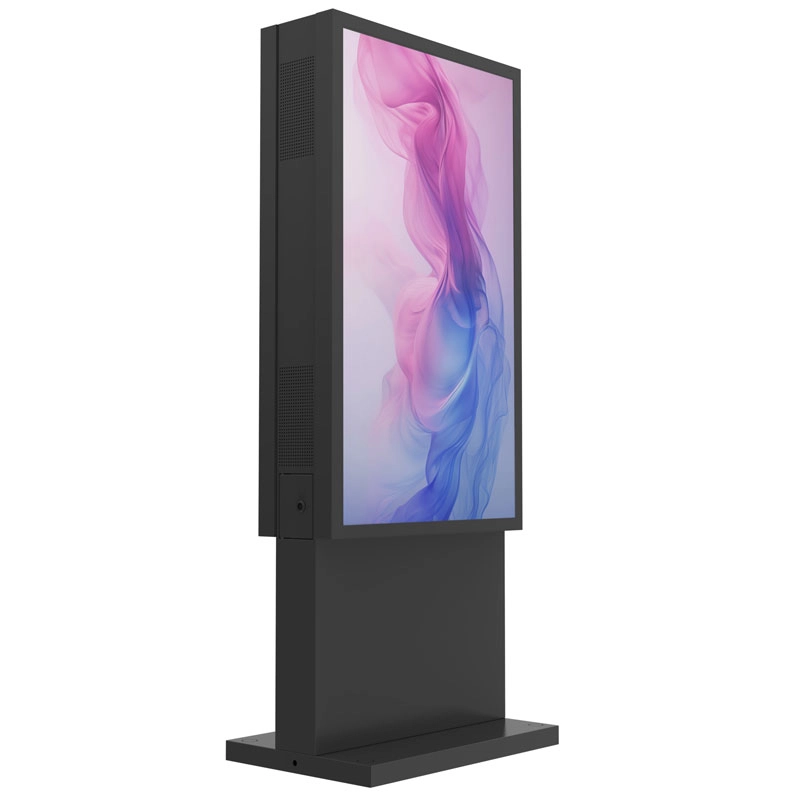
LumiLink digital outdoor advertising...
More"One person can move it" is the central promise of a wheeled digital poster display, and it deserves to be tested against real ground rather than a showroom floor. The practical envelope is this:
Weight. 35 kg (32-inch), 40 kg (43-inch) and 65 kg (55-inch). Rolling on two solid wheels, the effective effort on smooth paving is a fraction of the dead weight - the unit behaves like a loaded hand truck. Lifting is where weight becomes real, and lifting should be the exception, not the routine.
Balance. The battery cabinet sits low in the rear of the chassis. That is deliberate: it pulls the centre of gravity down and back, so the unit is stable when standing and easy to control when tilted onto the wheels. A tall screen with a low mass is easier to steer than the same screen with the mass high up.
Ground. Paved surfaces - pavement, plaza, asphalt, indoor tile - are the designed territory. Kerbs and drainage channels are crossed by tilting back onto the wheels and stepping the front edge over. Gravel, grass and sand are genuinely a two-person job, and where the position is permanent and unpaved, a fixed installation is the honest recommendation rather than a wheeled unit.
Stairs. Steps are the one condition where the wheeled format loses to its siblings. A folded A-frame digital board or a foldable poster display handles stairs; a 65 kg wheeled cabinet does not. If the daily route includes a stairwell, choose the lighter format and accept the lifting.
Ground conditions and what they mean for a wheeled unit:
| Ground type | Rolling | Practical advice |
|---|---|---|
| Indoor tile / showroom floor | Effortless | Roll at half weight; use for indoor repositioning and storage moves |
| Paved pavement / plaza / asphalt | Easy, ideal | The designed surface - one operator, one hand on the handle |
| Kerbs and drainage channels | Manageable with a lift | Tilt back onto the wheels, lift the front edge, step across one edge at a time |
| Gravel, grass, sand | Difficult two-person job | Plan a paved route; for permanent soft-ground positions use a fixed install |
| Ramps and steps | Ramps yes (gentle), steps no | A folded A-frame or foldable poster is the better format where stairs are unavoidable |
Roll anywhere, lift nothing: two solid rubber wheels, a shoulder-height top handle and a base lift handle let one operator reposition a 35-65 kg screen alone - the defining feature of a mobile digital poster stand.
14 hours of cordless playback: a 40,000 mAh (32-inch) or 50,000 mAh (43/55-inch) blade battery covers a full trading day on one charge, with a 7-hour overnight recharge - no outlet needed where the unit is parked.
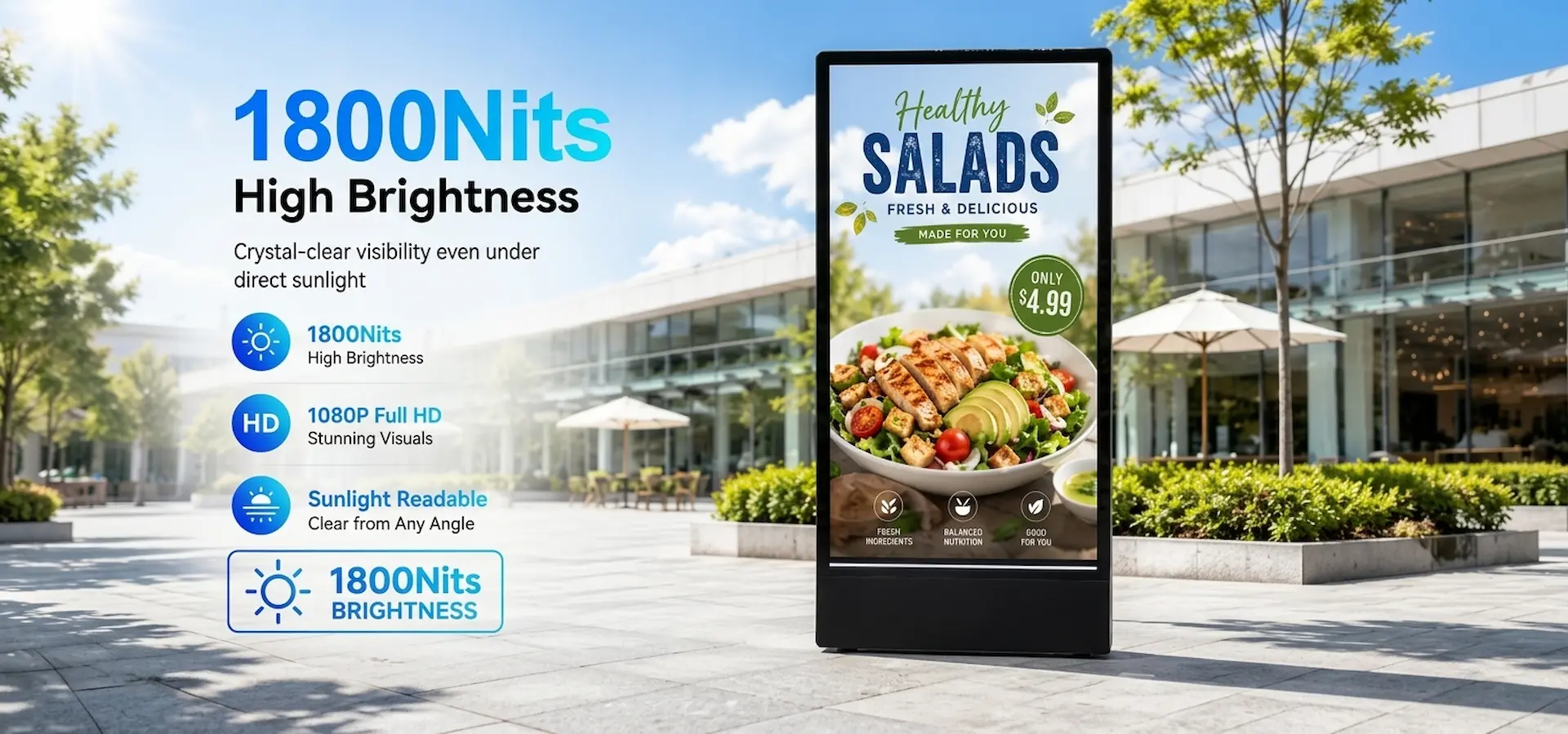
1,800-2,000 cd/m2 sunlight-readable panel: 1,800 cd/m2 on 32 and 43-inch models, 2,000 cd/m2 on the 55-inch, with 3,500:1 contrast and an ambient light sensor that matches brightness to conditions and conserves battery as daylight fades.
IP65 galvanized-steel cabinet: dust-sealed and rain-jet protected across the whole cabinet, tested from -50 C to 110 C with wind-cooled heat dissipation - so an overnight outdoor stay is not a risk.
Adjustable screen tilt: the display face tilts so it can be levelled on uneven pavement and angled slightly down to face pedestrians - useful both visually and aerodynamically.
Lockable battery compartment: the battery and electronics sit behind a keyed door, so the unit can be left unattended in public without exposing the pack.
Wi-Fi, 4G and USB content routes: Android 7.1.1 playback with cloud CMS scheduling, USB plug-and-play for offline sites and OTA updates across a fleet.
Two-channel audio and modular internals: stereo output for campaigns with sound, and drop-in player board, battery pack and panel modules for low-cost servicing over a multi-year life.
| Parameter | 32-inch | 43-inch | 55-inch |
|---|---|---|---|
| Panel Type | 32”LED Panel | 43”LED Panel | 55”LED Panel |
| Display Area | 697.8×392.2mm(W×H) | 943×531mm(W×H) | 1209.6×680.4mm(W×H) |
| Aspect Ratio | 16:9 | 16:9 | 16:9 |
| Backlight | Patented modular LED backlight with constant-current driver | Patented modular LED backlight with constant-current driver | Patented modular LED backlight with constant-current driver |
| Resolution | 1080×1920 | 1080×1920 | 1080×1920 |
| Display Colors | 16.7M | 16.7M | 16.7M |
| Brightness | 1,800 cd/m², sunlight-readable | 1,800 cd/m², sunlight-readable | 2,000 cd/m², sunlight-readable |
| Contrast Ratio | 3,500:1 | 3,500:1 | 3,500:1 |
| Viewing Angle | 178°(H) / 178°(V) | 178°(H) / 178°(V) | 178°(H) / 178°(V) |
| Response Time | 5ms | 5ms | 5ms |
| Color System | PAL/NTSC/SECAM | PAL/NTSC/SECAM | PAL/NTSC/SECAM |
| Operating Lifetime | 60,000 hours | 60,000 hours | 60,000 hours |
| CPU | Cortex-A7, 1.2 GHz | Cortex-A7, 1.2 GHz | Cortex-A7, 1.2 GHz |
| Memory | DDR3 1GB | DDR3 1GB | DDR3 1GB |
| Storage | Up to 32GB TF card expansion | Up to 32GB TF card expansion | Up to 32GB TF card expansion |
| Decoding Resolution | Up to 1080P | Up to 1080P | Up to 1080P |
| Operating System | Android 7.1.1 | Android 7.1.1 | Android 7.1.1 |
| Network | 3G/4G, Ethernet, Wi-Fi, wireless peripheral expansion | 3G/4G, Ethernet, Wi-Fi, wireless peripheral expansion | 3G/4G, Ethernet, Wi-Fi, wireless peripheral expansion |
| Video Formats | 30+ formats: AVI, MKV, MP4, MOV, WMV, FLV, TS, 3GP, MPG, VOB etc. | 30+ formats: AVI, MKV, MP4, MOV, WMV, FLV, TS, 3GP, MPG, VOB etc. | 30+ formats: AVI, MKV, MP4, MOV, WMV, FLV, TS, 3GP, MPG, VOB etc. |
| Image Formats | BMP / JPEG / PNG / GIF | BMP / JPEG / PNG / GIF | BMP / JPEG / PNG / GIF |
| USB Interface | 2× USB HOST ports + 2× USB expansion | 2× USB HOST ports + 2× USB expansion | 2× USB HOST ports + 2× USB expansion |
| System Update | USB / SD card / remote OTA update | USB / SD card / remote OTA update | USB / SD card / remote OTA update |
| Battery Technology | Blade battery, long runtime, stable performance | Blade battery, long runtime, stable performance | Blade battery, long runtime, stable performance |
| Charging Time | 7 hours | 7 hours | 7 hours |
| Runtime per Charge | 14 hours | 14 hours | 14 hours |
| Battery Capacity | 40000 mAh | 50000 mAh | 50000 mAh |
| Input Voltage | 24V | 24V | 24V |
| Operating Temperature | -50°C ~ 110°C | -50°C ~ 110°C | -50°C ~ 110°C |
| Storage Temperature | -45°C ~ 80°C | -45°C ~ 80°C | -45°C ~ 80°C |
| Operating Humidity | 10% ~ 90% | 10% ~ 90% | 10% ~ 90% |
| Storage Humidity | 10% ~ 90% | 10% ~ 90% | 10% ~ 90% |
| Power Input | AC100V ~ 240V | AC100V ~ 240V | AC100V ~ 240V |
| Power Consumption | ≤100W | ≤100W | ≤100W |
| Standby Power | ≤3W | ≤3W | ≤3W |
| Color Options | Silver / Grey / White / Black / Red | Silver / Grey / White / Black / Red | Silver / Grey / White / Black / Red |
| Enclosure Material | Galvanized steel + outdoor-grade powder coating | Galvanized steel + outdoor-grade powder coating | Galvanized steel + outdoor-grade powder coating |
| Certification | ISO9001, 3C, FCC, UL | ISO9001, 3C, FCC, UL | ISO9001, 3C, FCC, UL |
| Net Weight | 35Kg | 40Kg | 65Kg |
| Gross Weight | 38Kg | 48Kg | 87Kg |
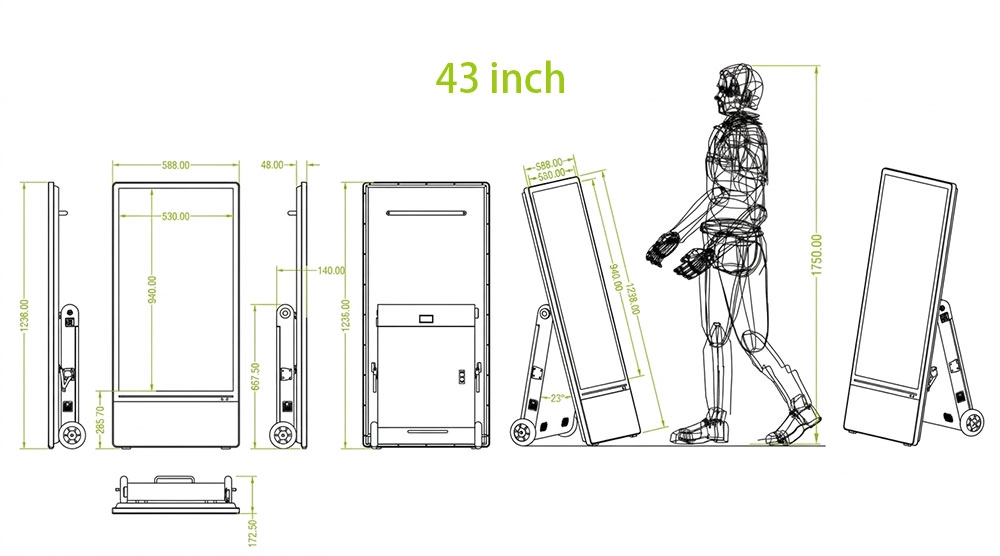
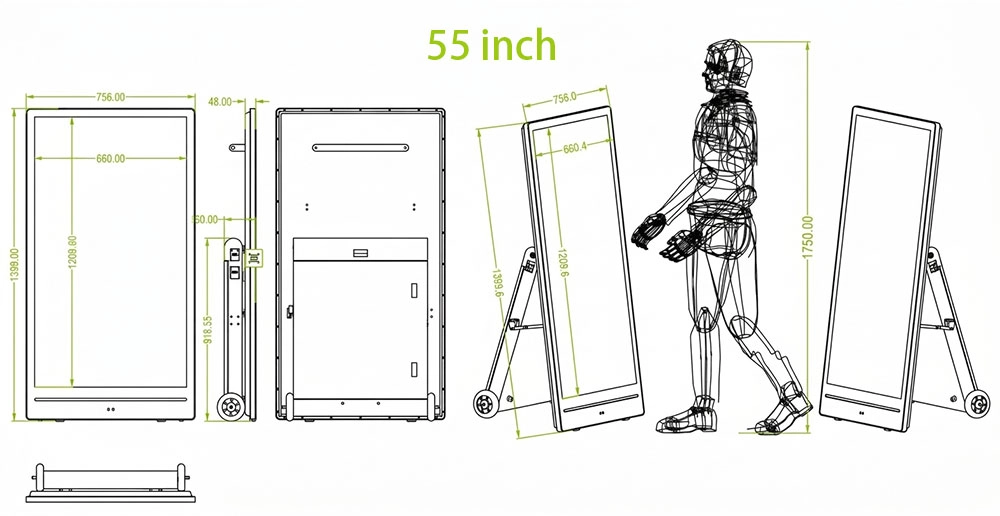
| Product Dimensions | 990mm×148mm×448mm | 1236mm×148mm×588mm | 1400mm×148mm×756mm |
| Package Dimensions | 1100mm×300mm×600mm | 1350mm×300mm×700mm | 1580mm×345mm×930mm |
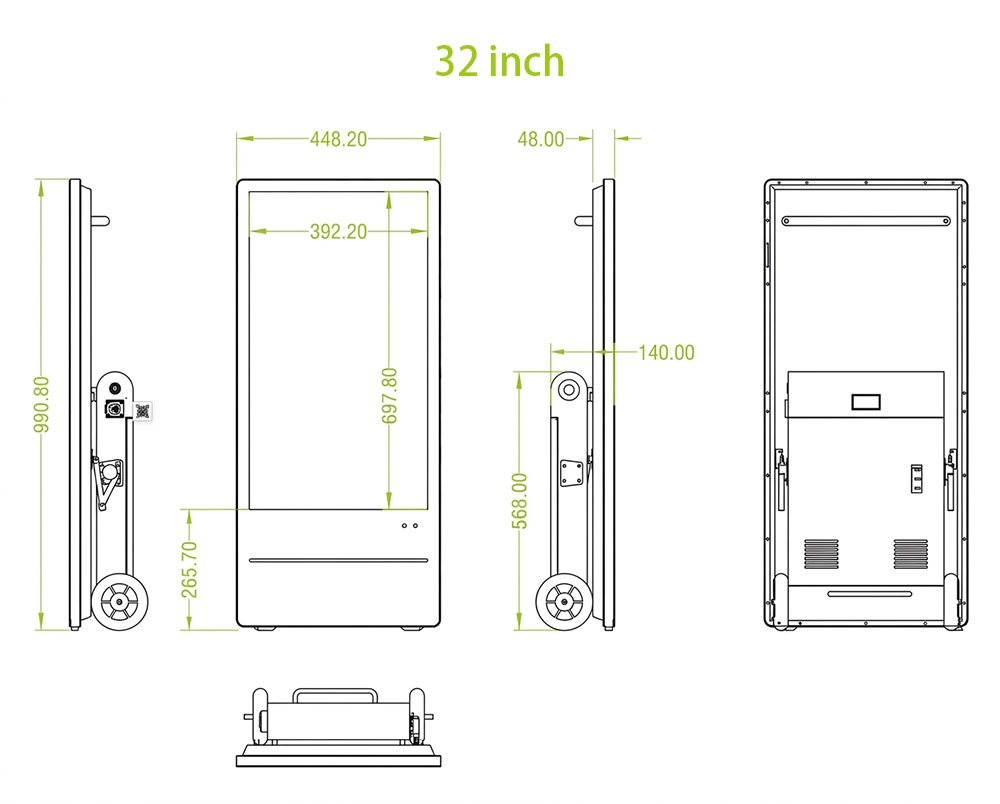
Size & Dimensions - engineering drawings with human-scale reference for all three models. Check the folded footprint against your storage area and the wheel track against your narrowest doorway before ordering.
Yes, on paved ground. The two solid rubber wheels and the shoulder-height top handle turn the unit into a two-wheeled trolley, so a 35 kg, 40 kg or even 65 kg screen rolls with a fraction of its dead weight in effort. The limits are stairs, gravel and loose sand - those need two people or a lighter format. Kerbs can be crossed by tilting back onto the wheels and lifting the front edge.
The 32-inch model weighs 35 kg, the 43-inch 40 kg and the 55-inch 65 kg. All three are portrait Full-HD 1080x1920 with 178/178 viewing angles and share the same chassis design. Dimension drawings for every model appear in the specifications section above, including the footprint when parked.
A full charge delivers 14 hours of continuous playback - a complete trading day - and recharges in 7 hours overnight. The 32-inch model uses a 40,000 mAh blade battery; the 43 and 55-inch models use a 50,000 mAh pack. Because the ambient light sensor trims backlight output in shade and after dark, mixed indoor-outdoor duty often runs longer than the rated figure.
The low-mounted battery cabinet keeps the centre of gravity close to the ground, which is the main reason the unit stands firmly. In gusting conditions, park the unit on level ground, turn the screen face slightly away from the prevailing wind, tilt the display downward, and keep the battery compartment locked. As with any portable screen, bring it indoors ahead of a severe storm warning.
Yes. Panels are rated 1,800 cd/m2 (32 and 43-inch) and 2,000 cd/m2 (55-inch) with 3,500:1 contrast, and anti-reflective tempered glass suppresses surface glare - roughly twice the brightness of typical indoor-grade portable units, which wash out in midday sun.
The cabinet is IP65 rated - dust-tight and protected against rain jets - with a galvanized steel body and outdoor powder coating, and the operating range covers -50 C to 110 C. Overnight outdoor placement is within design intent; extreme storms and flooding are not, and the unit should be moved indoors for those.
Neither. The battery removes the power requirement, and content is updated over Wi-Fi or optional 4G where a network exists, or by USB stick where it does not. That is what allows the unit to be parked on a pavement, plaza or event ground with no infrastructure at all.
Through the cloud CMS: schedule playlists per unit and per daypart, push updates over Wi-Fi or 4G, and monitor playback remotely. For sites without connectivity, export the playlist to a USB stick and the player syncs it automatically. Firmware updates arrive over the air, so a deployed fleet stays current.
Manufacturing is certified under ISO9001, 3C, FCC and UL. Two years of warranty on the full unit with lifetime technical support, and replacement parts remain available for 5+ years after purchase - including wheels, handles and battery packs as separate modules.
A portable screen that topples is worse than no screen at all, so stability deserves a section of its own. Three design details decide whether a wheeled digital poster stays put.
Centre of gravity. The battery - the single heaviest component - is mounted low in the rear cabinet and centred over the wheelbase. That placement is why a tall screen still behaves like a stable object rather than a sail on legs.
Screen tilt as an aerodynamic tool. The tilt mechanism is normally discussed as a viewing-angle feature, and it is - but a screen angled slightly downward presents a smaller flat surface to horizontal wind than a perfectly vertical one. On exposed ground, a small downward tilt improves both legibility and stability.
Position relative to the wind. In practice, orientation matters as much as hardware. Parking the unit broadside to a gusting wind loads the largest possible area; angling the cabinet 20-30 degrees into the wind keeps the profile narrower and lets the wheelbase do its work. For any position exposed to regular strong wind, we recommend the heavier 55-inch chassis rather than a lighter unit, and a paved, level standing spot.
The rule we give buyers is simple: a wheeled unit is stable by design on level paved ground, and marginal on soft, sloping or wind-exposed ground. If your chosen position is the latter, choose a fixed installation - the wheeled format is not the right tool.
Manufacturers quote weight in kilograms; operators experience it as effort. On a mobile digital poster stand, that difference decides whether the unit is redeployed every day or left where it stands. Here is the same weight data translated into what each model actually asks of the person moving it.
32-inch, 35 kg. The lightest wheeled unit. Rolls easily, and is light enough that the bottom lift handle can be used to carry it up a short flight of steps if necessary. Best where the route includes a threshold, a short ramp or a lift.
43-inch, 40 kg. The volume seller. Five kilograms heavier than the 32-inch for roughly 40% more screen area - the best balance of impact and handling in the range. Rollable by one person all day on paved ground.
55-inch, 65 kg. The impact model for plazas, forecourts and event grounds. It rolls well on smooth paving because the chassis geometry carries the load, but it should never be lifted far, and its route should be checked for gravel, slopes and kerbs in advance. Where the 55-inch will stand in one position for weeks at a time, weight stops being a daily concern at all.
A note on packing weight for freight: gross weights are higher - 38 kg, 48 kg and 87 kg for the 32, 43 and 55-inch cartons - because of the foam-lined export packaging. Plan vehicle capacity on the gross figure.
Delivering Sunlight-Readable, All-Weather Digital Signage to Global Brands
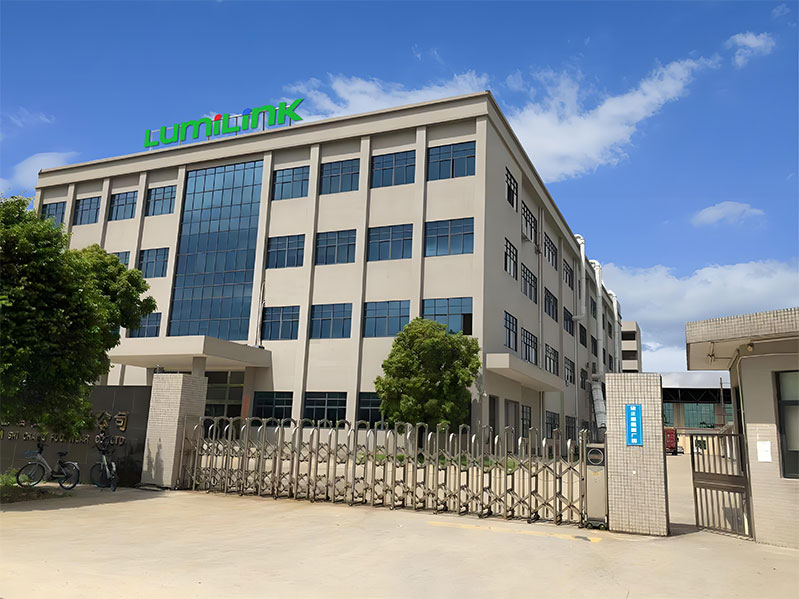
Established in 2014, Shenzhen Lumi Link Technology Co., Ltd. is a modern high-tech manufacturer focusing on intelligent display equipment. We specialize in professional consoles, digital outdoor advertising screens, and integrated command center solutions for a global client base.
Our core product line covers High-Brightness Outdoor LCD Displays for DOOH advertising, Sunlight-Readable Window Displays for retail storefronts, and durable Outdoor Digital Signage Totems for transit and smart city projects. We also offer bespoke Double-Sided Advertising Screens that maximize visibility from both directions of pedestrian flow.
With ISO 9001 certification and a dedicated R&D team, we provide full OEM/ODM services. From IP65 weatherproof enclosures for coastal cities to 5,000-nit panels for equatorial markets, our digital outdoor advertising screens are exported globally to over 50 countries.
10+ years of industrial experience
1000+ successful project cases
Shipping to 50+ countries and regions
200+ Achievement customers
20+ Technical patents
5000sqm production base

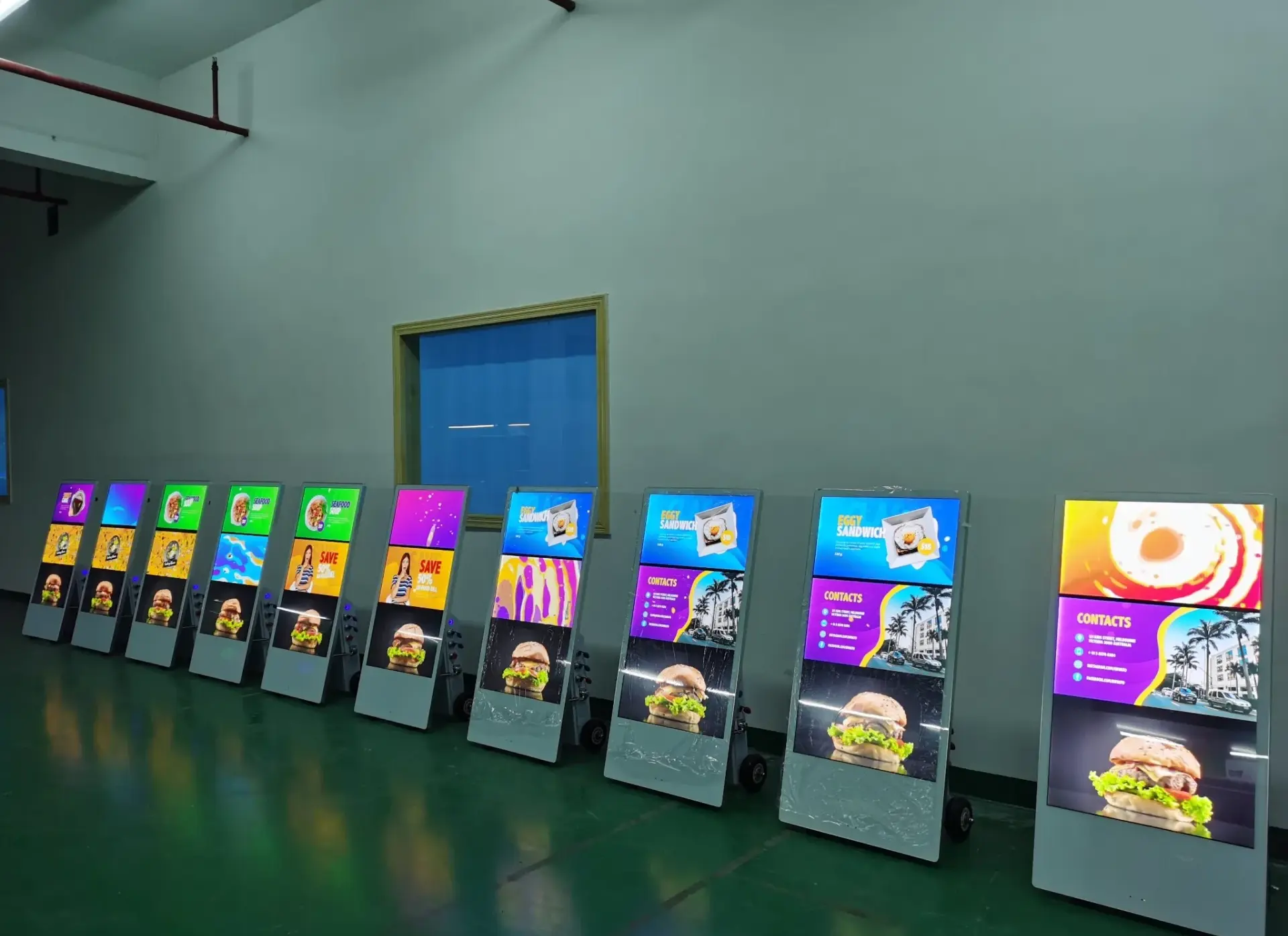
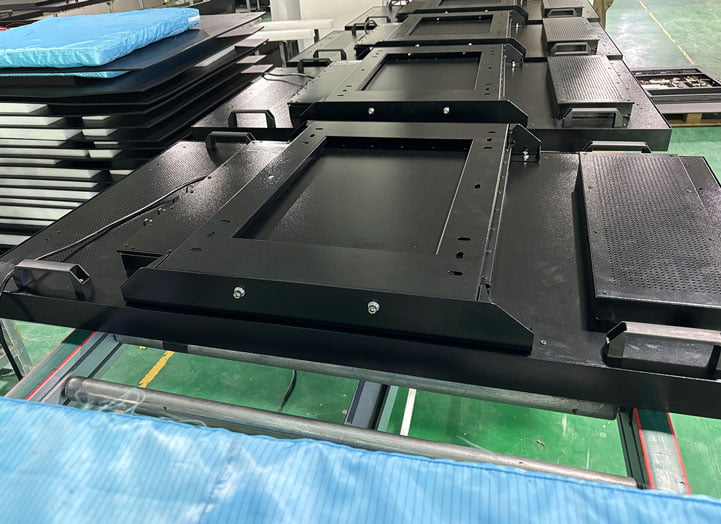
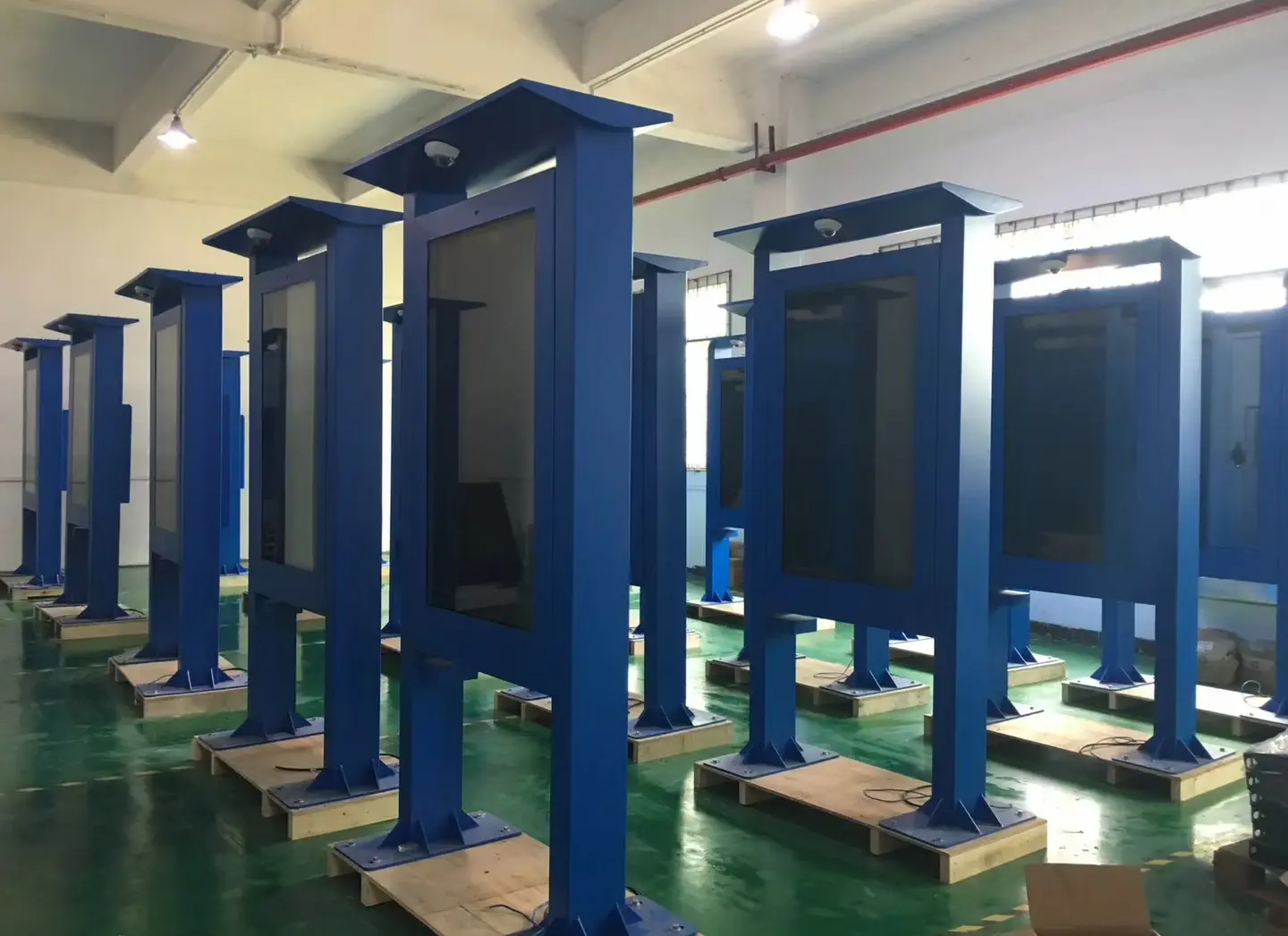
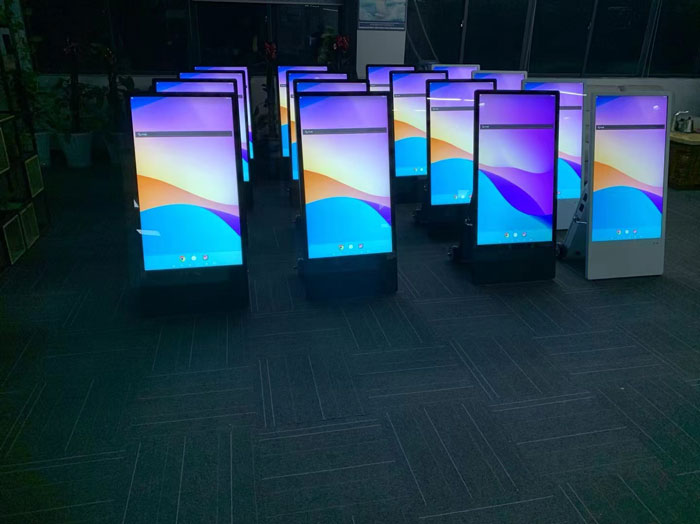
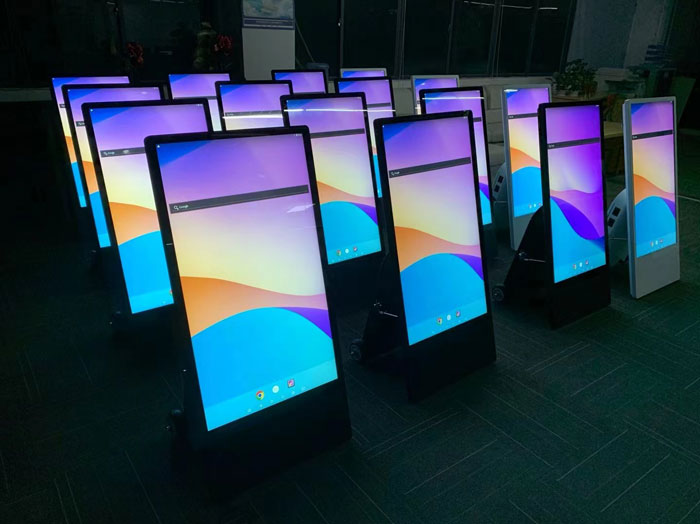
A rollable advertising screen earns its premium by being in the right place at the right hour, so the daily route is worth designing before the unit arrives.
Map the stops, then the order. List every position the screen should occupy in a day - morning entrance, lunchtime frontage, evening event gate - and the walking distance between them. If the total exceeds a few hundred metres on paved ground, the wheeled format is clearly justified.
Check the narrowest point, not the widest. A doorway, a service gate or a lift entrance usually sets the practical limit. Measure the narrowest gap on the route and compare it with the chassis footprint before committing.
Pick the charging location first. The unit needs 7 hours of recharge somewhere safe, indoors, near a socket. Choosing that spot in advance - rather than after the first day - is what makes the overnight cycle reliable.
Schedule the content to the route. Because every playlist can be scheduled per daypart in the CMS, the screen can switch automatically from a breakfast offer to a lunch menu to an evening event promotion while the operator is busy with customers. The route plan and the content plan should be written together.
Mobility should not mean manual content. A wheeled digital poster runs Android 7.1.1 with three update routes, so the screen can be repositioned without anyone touching a USB stick.
Cloud CMS over Wi-Fi or 4G. Schedule playlists per unit, per daypart and per location from one dashboard, push updates over Wi-Fi or the optional 4G module, and monitor playback status remotely. A fleet spread across several sites is managed from a single browser tab.
USB plug-and-play. Where connectivity is unreliable - markets, rural events, construction sites - export the playlist to a USB stick and the player syncs and loops it automatically. Loading a new campaign takes under a minute.
OTA system updates. Firmware and player software update over the air, so deployed units stay current without recall. Playback supports 30+ video formats, common image formats and scrolling text, with storage expandable to 32GB.
Because the player is the same across the portable range, a campaign built for a wheeled plaza unit can be pushed to an A-frame or foldable screen the same day - one content library, several formats, no re-authoring.
Wheeled hardware is exposed to more handling than any other display category, in transit and in service, so packaging and spare-part supply are part of the specification.
Export-grade packing. Each unit ships in a foam-lined carton sized to the folded footprint, with the battery packed under certified documentation for air and sea freight. Standard cabinet colours are silver, grey, white, black and red.
Serviceable by module. The player board, battery pack and display panel are separate drop-in modules - and so are the consumable mechanical parts. Wheels, handles and the tilt mechanism can be replaced without returning the unit, which matters because those are the components that wear in daily rolling use.
Factory-direct supply and support. Lumi Link manufactures in-house under ISO9001 with 3C, FCC and UL certification. Two years of warranty on the full unit, lifetime technical support with 24-hour weekday response, and replacement parts available for 5+ years after purchase. Whether you need one wheeled unit for a storefront pilot or a fleet of mobile screens across several cities, the deployment team helps plan routes, charging schedules and CMS structure before the first unit ships.
Our excellent sales and technical team help your business find the best Rol rate