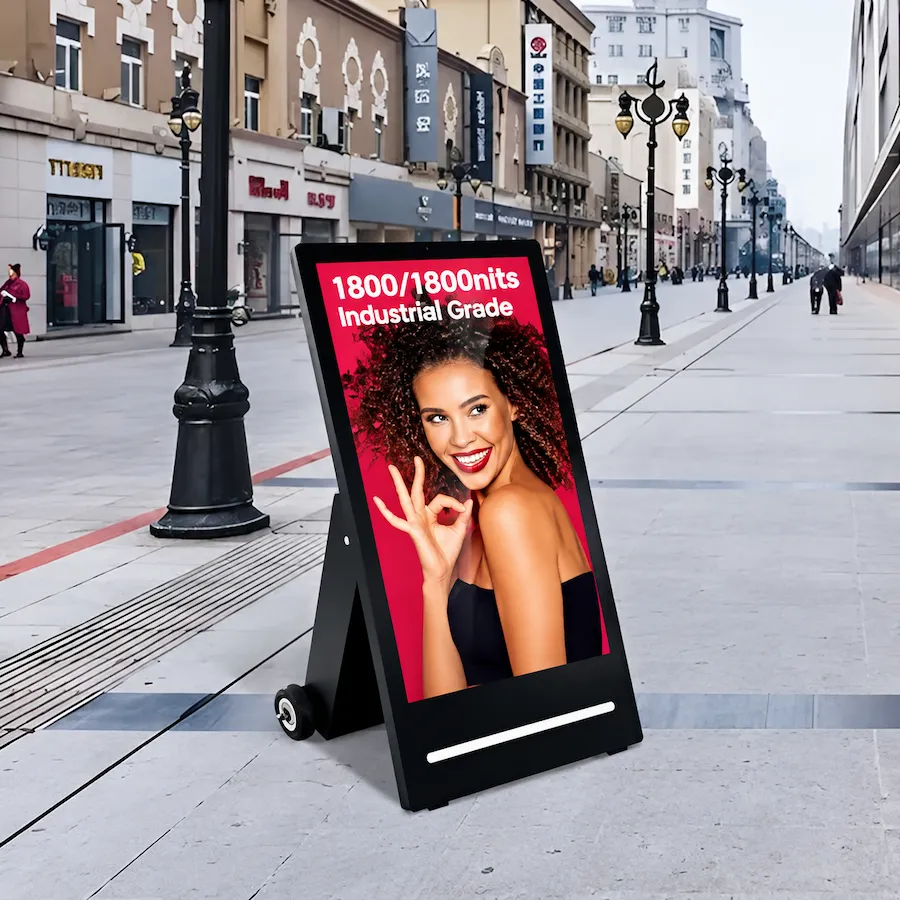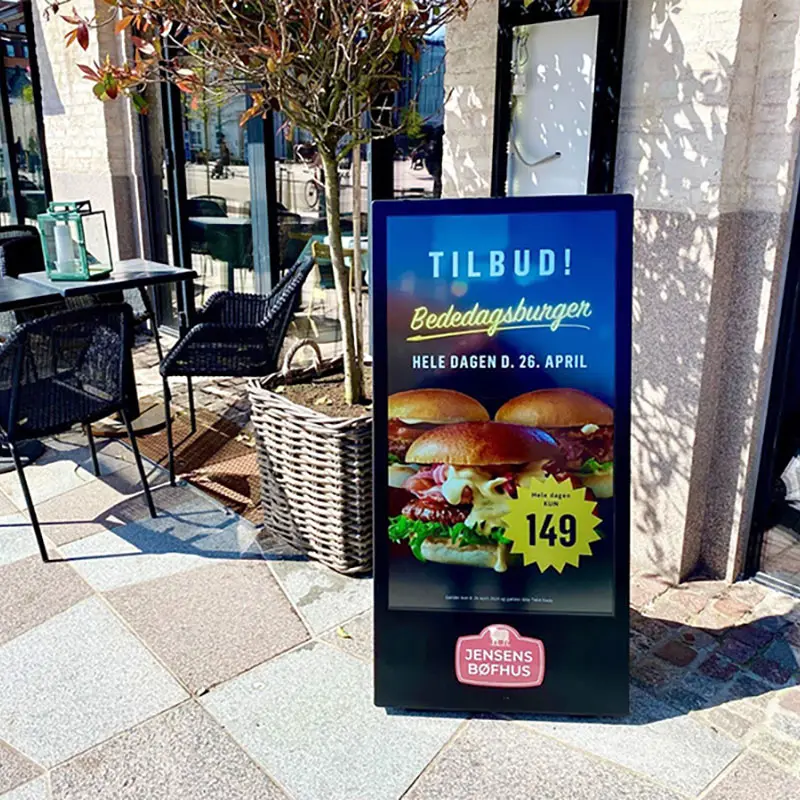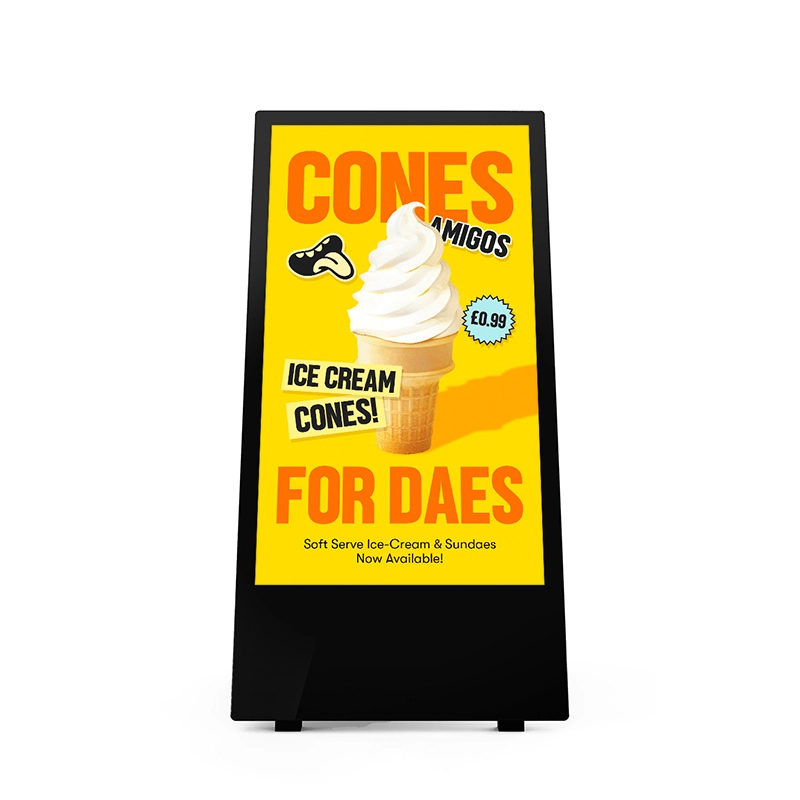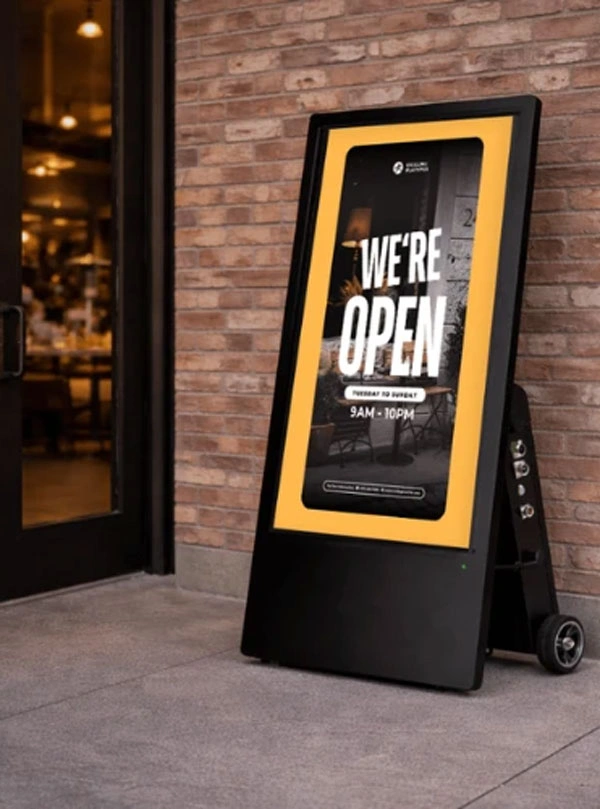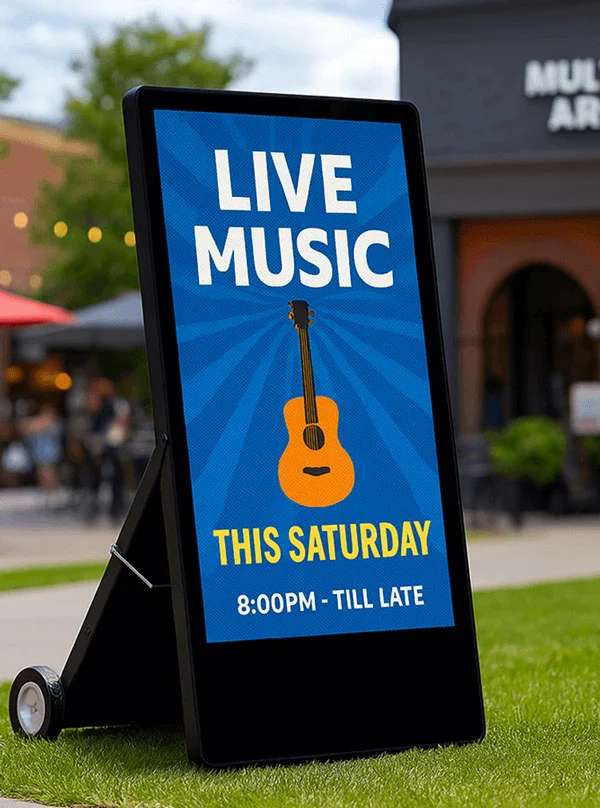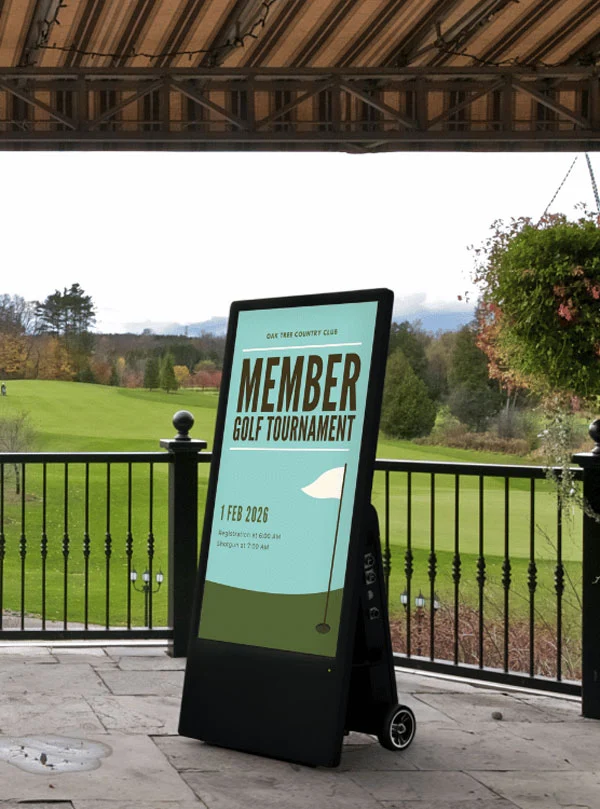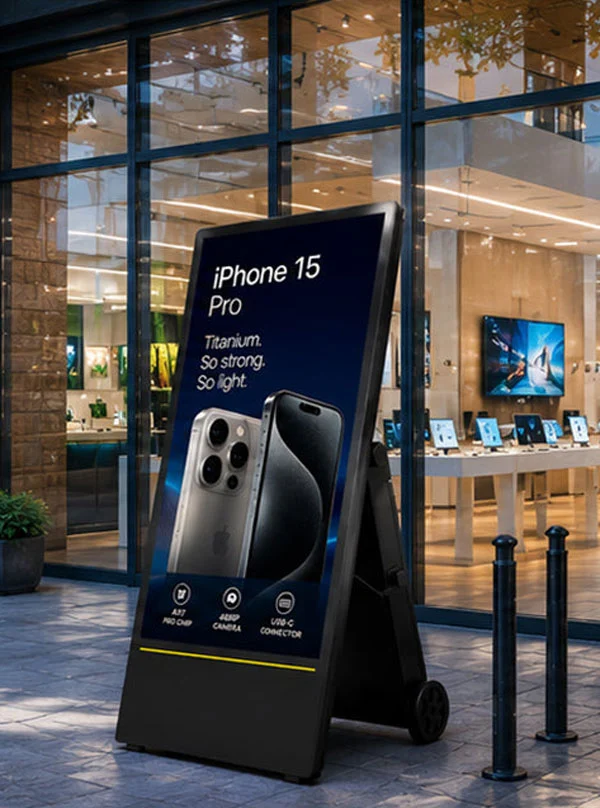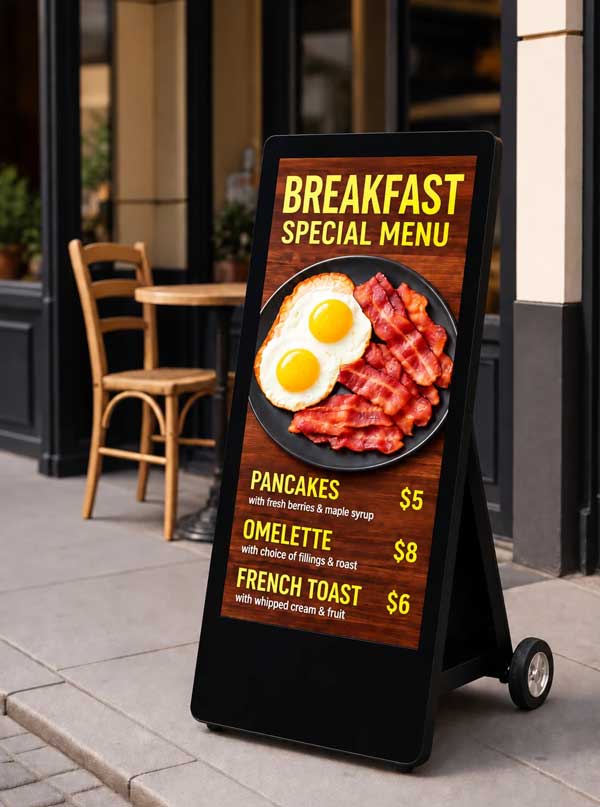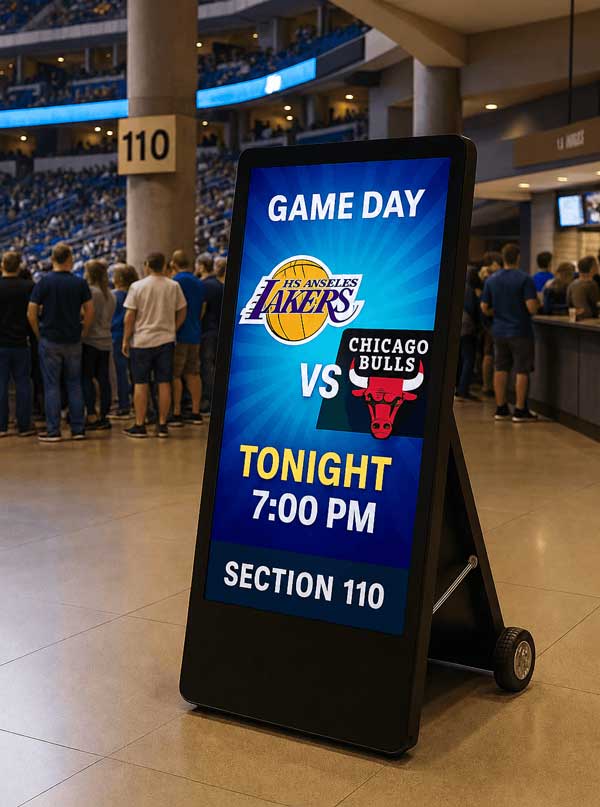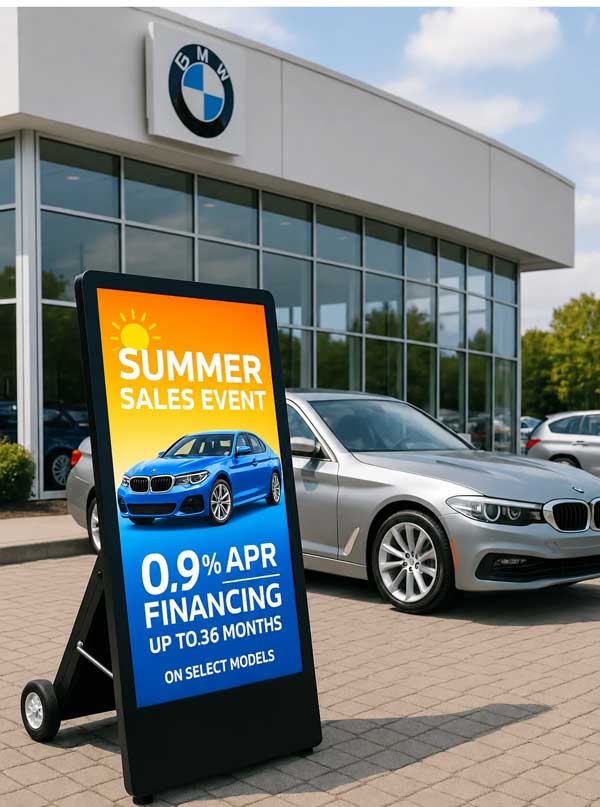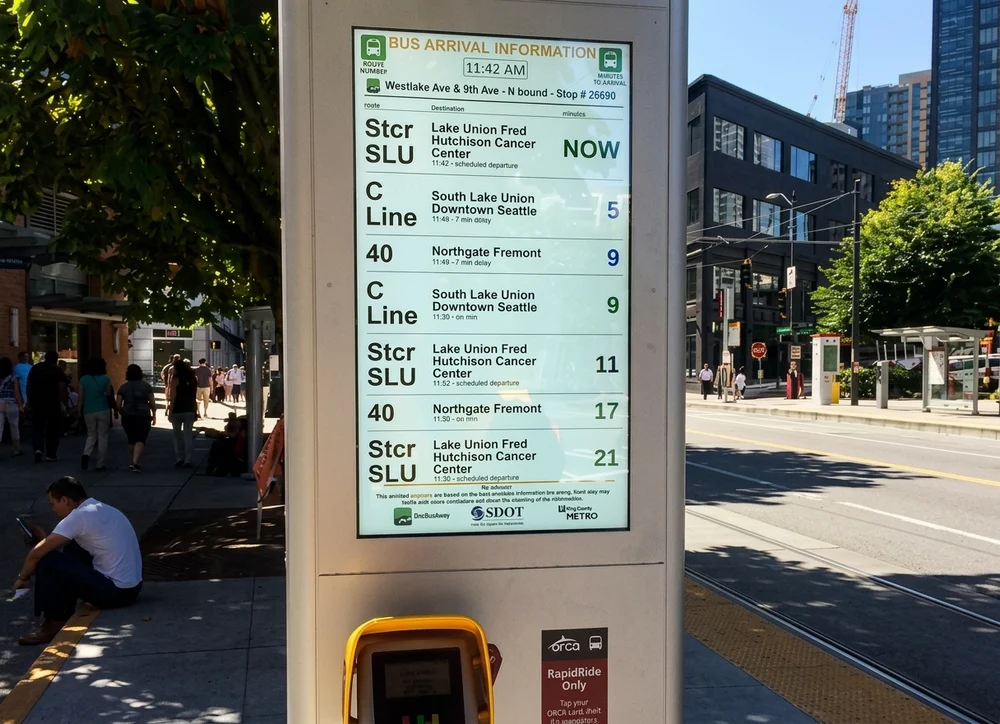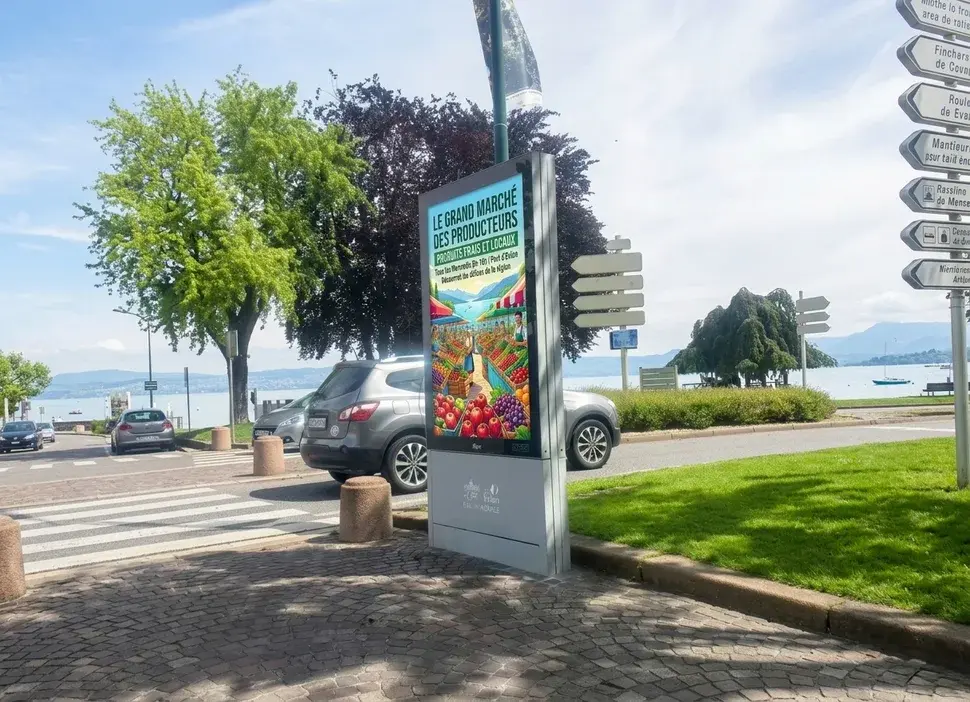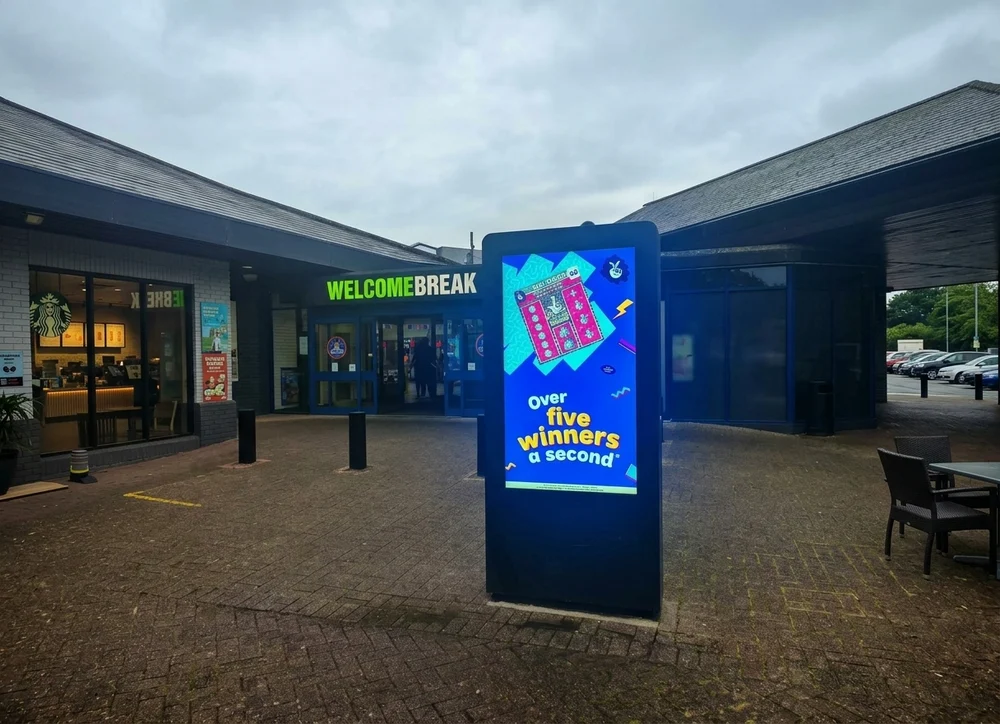
A curbside advertising display is built for one job: to be read by people who are moving. LumiLink supplies it as a self-contained cordless unit - a 1,800-2,000 cd/m2 panel in an IP65 cabinet with a 14-hour blade battery - so a message can be placed at the kerb, at a forecourt entrance or on a street corner without trenching a cable or asking for a permanent structure. The engineering question is not how bright the screen is, but whether the message still reads at the distance and the angle the street actually presents.
Street-side advertising has always had two audiences, and they behave nothing alike. A pedestrian gives the message three to five seconds at two to six metres and can stop if something catches. A driver gives it well under two seconds at ten to twenty times that distance, and cannot stop at all. A roadside advertising screen that is designed for one and placed for the other is a wasted deployment, which is why the audience question comes before the hardware question.
The two cases also differ in what the message can carry. The pedestrian can read a price, a product and a time limit. The driver, at speed, can take in roughly one idea - a logo, a colour, a single short word - and only if it is large enough and on screen long enough to be seen. Nobody buys anything from a moving car, so the realistic roadside objective is recognition and direction rather than detail: which turning to take, which forecourt to pull into.
That distinction shapes everything downstream - the panel size, the mounting height, the angle it is set at, and the content that runs on it. A display that reads beautifully to a queue outside a shop will read as a bright blur to traffic, not because the screen is poor but because the content was never sized for the distance.
Where the deployment is aimed at a pavement audience in front of a shop rather than a road audience, the format to compare is the pavement advertising board, which is optimised for the shorter reading distance.


Signage has used a simple legibility rule for decades, and it applies to screens as much as to painted boards: for every 25 mm / 1 in of capital letter height, allow roughly 3 m / 10 ft of reading distance. Turn that around and you get the table below - which is really a test of whether a portable panel suits the site at all.
| Reading distance | Cap height needed | What it covers |
|---|---|---|
| 3 m / 10 ft | about 25 mm / 1 in | Someone at the door or on the same pavement |
| 10 m / 33 ft | about 85 mm / 3.3 in | Across a two-lane street; a driver slowing for a junction |
| 20 m / 66 ft | about 170 mm / 6.7 in | A slow-moving vehicle or a wide plaza - the working limit of a 55-inch panel |
| 40 m / 130 ft | about 340 mm / 13 in | Fast traffic - beyond a portable panel; this needs a fixed large-format roadside unit |
The arithmetic has a blunt implication. A 55-inch panel placed at the kerb will comfortably serve readers out to about 20 m / 66 ft - a slow-moving vehicle, a wide plaza, a forecourt approach. Beyond that, the required cap height climbs faster than the screen grows, and the honest answer is a larger fixed-format unit rather than a portable one pushed past its design point.
There is a second half to the rule that buyers forget: a message is only legible if the whole of it fits within the reading time. A headline sized for 20 m is legible at that distance only if it stays on screen long enough for a driver to approach, read it and pass. Sizing the type and timing the slide are the same decision, and both belong to the placement, not the playlist.
Run the test on site before ordering: pace the actual reading distance from the kerb, work out the cap height it demands, and check that the panel can deliver it. If it cannot, the layout is wrong for that spot - or the spot is wrong for the format.
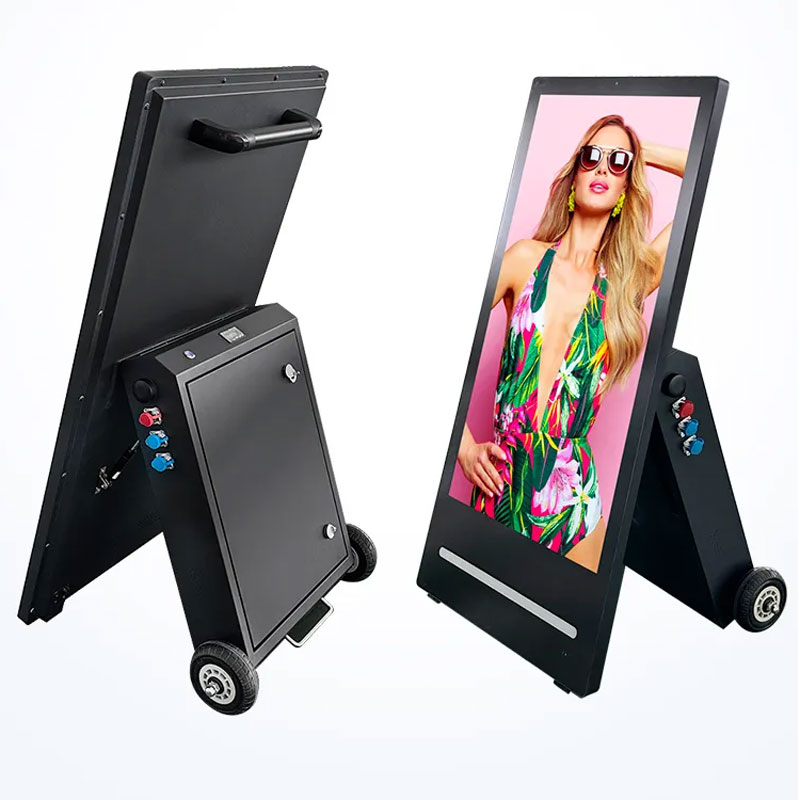
LumiLink foldable poster displays fo...
More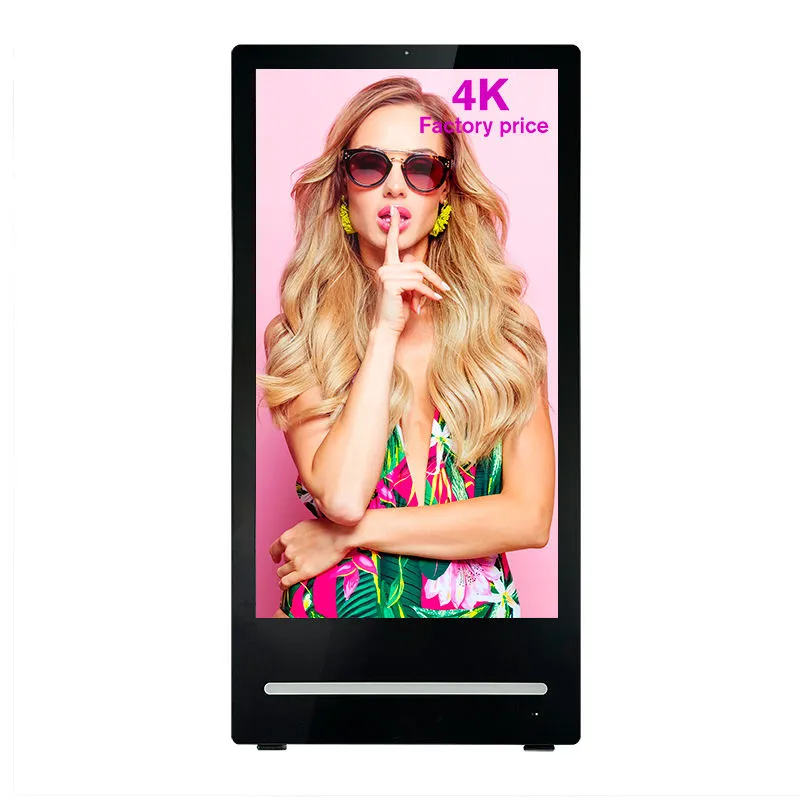
LumiLink A-frame digital boards mode...
More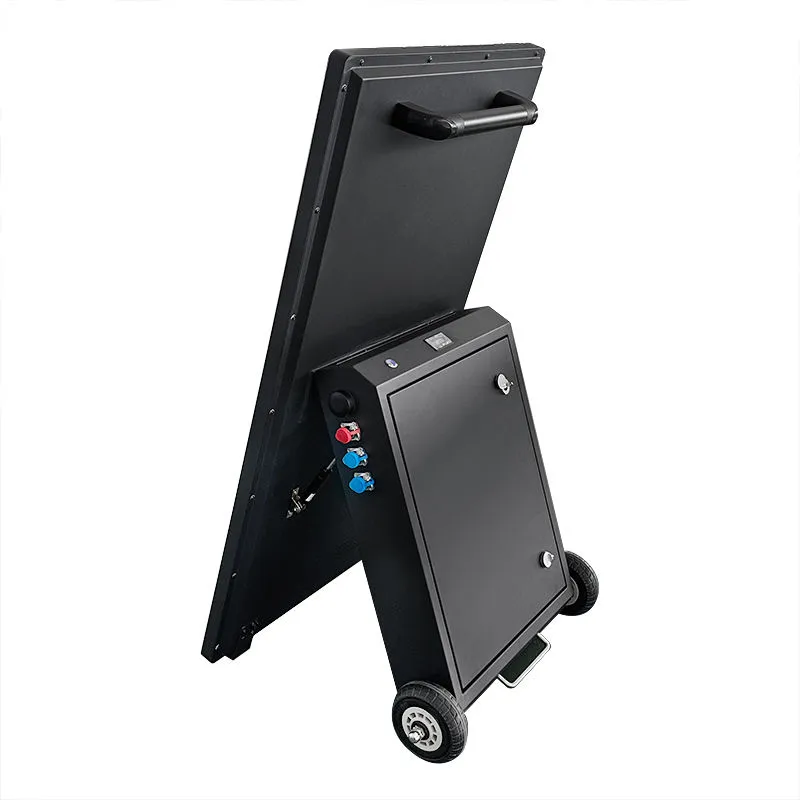
Battery powered digital signage with...
MorePortable outdoor digital signage in ...
More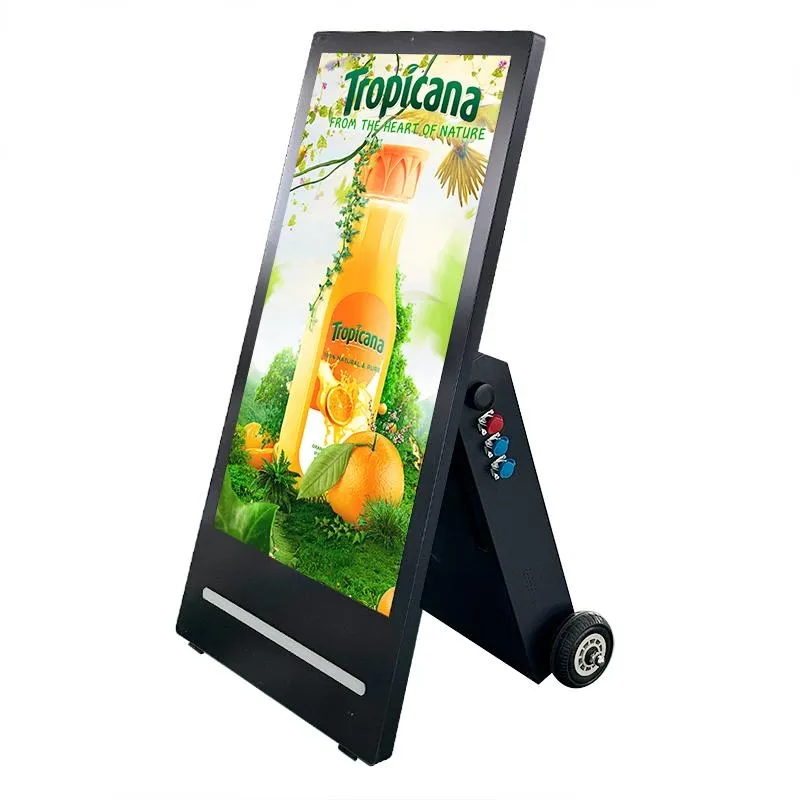
Digital poster on wheels for one-per...
More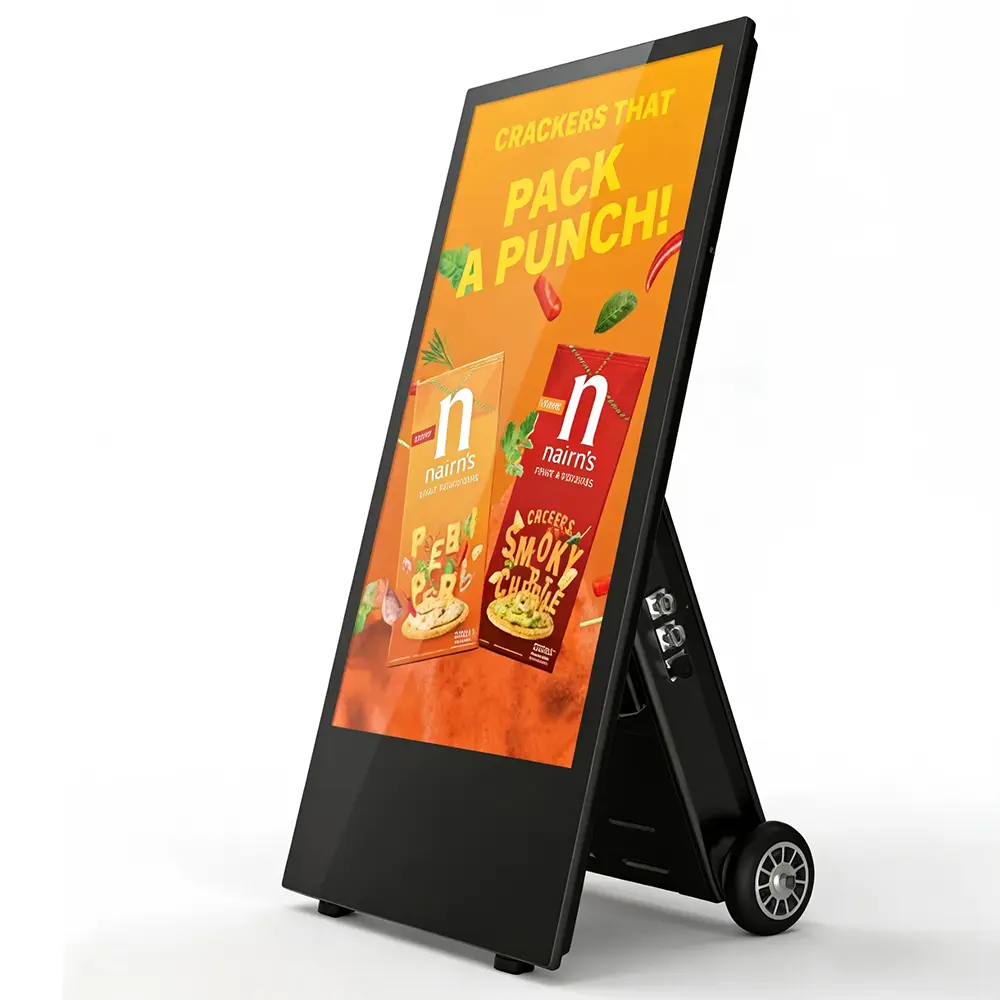
Digital sandwich board with 14-hour ...
More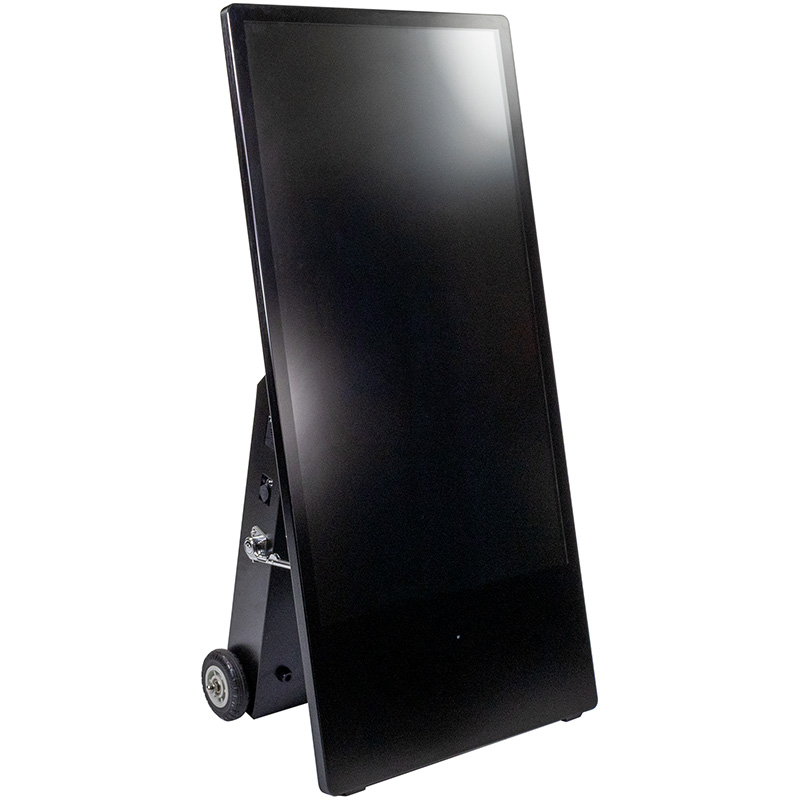
Pavement advertising board in 32/43/...
More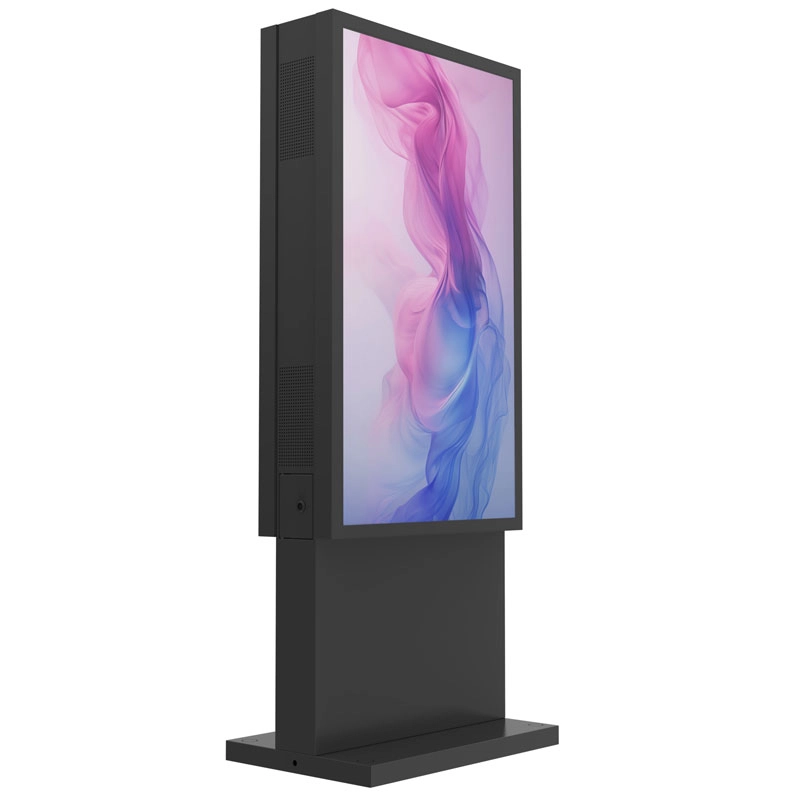
LumiLink digital outdoor advertising...
MoreBrightness is where a roadside advertising screen is won or lost, and not only because of the sun.
Daylight is the first test. The panel runs at 1,800 cd/m2 on the 32 and 43-inch models and 2,000 cd/m2 on the 55-inch, with 3,500:1 contrast behind anti-reflective tempered glass. That combination is what keeps a dark background dark and a white headline white at midday, instead of both drifting into the same pale grey.
Glare is the second, and it is directional. A kerbside panel often faces oncoming sun or the reflective facade opposite, and the offending angle changes by the hour. The anti-reflective coating reduces the worst of it, but placement still decides the rest: a panel turned away from the low morning sun reads better all day than one aimed directly into it.
Night is the third, and it is about restraint. An ambient light sensor trims the backlight after dark, so the panel stays readable without becoming a nuisance to neighbours or a distraction to drivers. In dense streets this is a large part of getting a placement accepted at all, and it is also what lets mixed duty run past the rated 14 hours.
The practical ordering is therefore: check the daytime legibility on site, check the solar aspect, then decide the panel size. Buyers who start with the size usually end up living with the glare.
Made to be seen at distance: 1,800-2,000 cd/m2 panels with 3,500:1 contrast and anti-reflective tempered glass, readable through daylight from across a street.
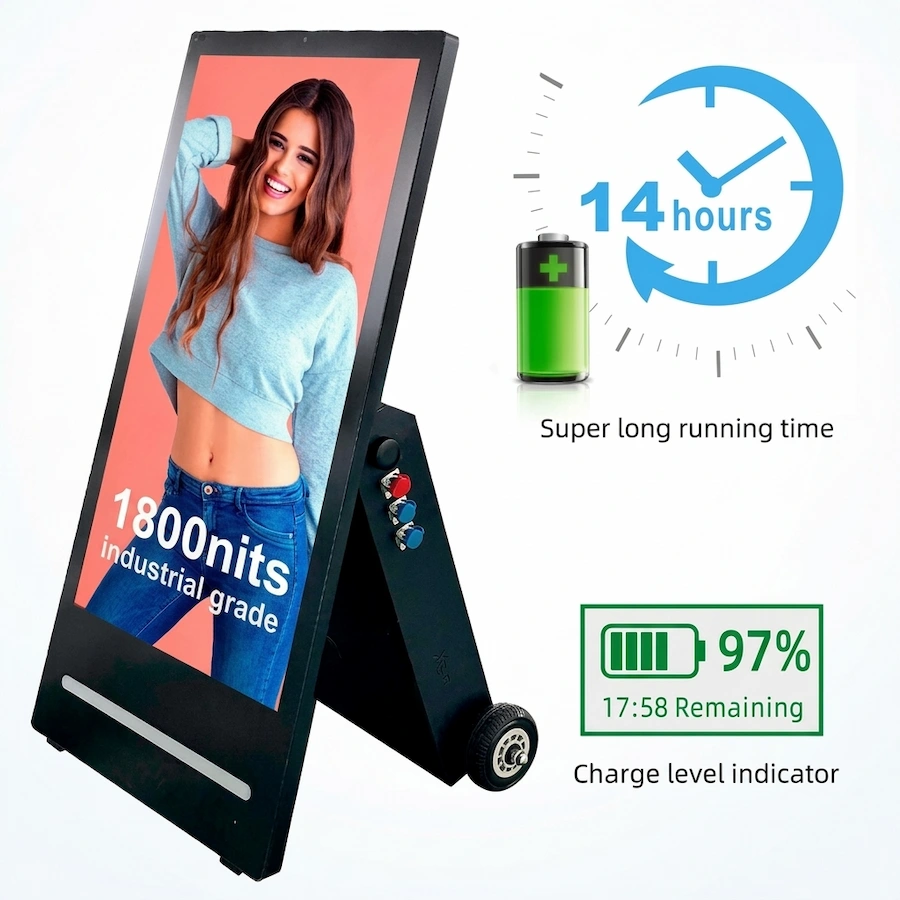
Cordless at the kerb: a 40,000 mAh blade battery on the 32-inch and 50,000 mAh on the 43 and 55-inch models give 14 hours of playback, so nothing is trenched and no cable crosses the footway.
Weather-sealed for street duty: IP65 galvanized steel cabinet, dust-tight and rain-jet protected, rated from -50 C to 110 C.
Auto-dimming after dark: an ambient light sensor keeps the panel visible at night without becoming a glare source for passing traffic.
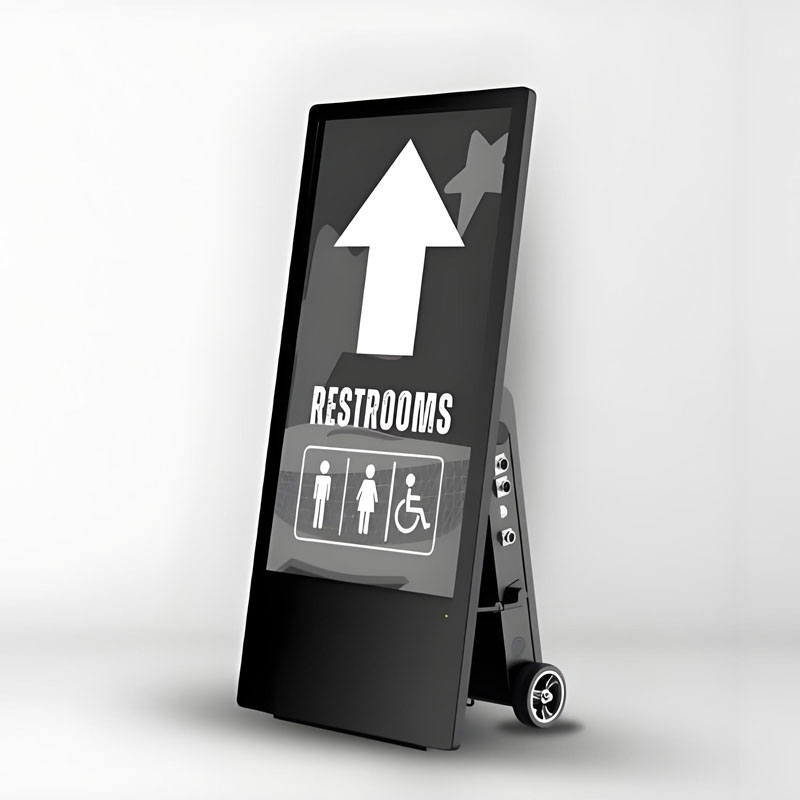
Portrait format for street messages: the vertical layout suits stacked headlines, price blocks and wayfinding arrows, which is how the most readable street-side creative is built.
One-person deployment: castors to roll it into position and foot pads to set it down, with no installation visit.
Remote content control: cloud CMS over Wi-Fi or 4G, USB plug-and-play for sites without signal, and over-the-air firmware updates.
Modular service: panel, player board, battery pack and mechanical wear parts replace individually, so multi-year ownership stays predictable.
| Parameter | 32-inch | 43-inch | 55-inch |
|---|---|---|---|
| Panel Type | 32”LED Panel | 43”LED Panel | 55”LED Panel |
| Display Area | 697.8×392.2mm(W×H) | 943×531mm(W×H) | 1209.6×680.4mm(W×H) |
| Aspect Ratio | 16:9 | 16:9 | 16:9 |
| Backlight | Patented modular LED backlight with constant-current driver | Patented modular LED backlight with constant-current driver | Patented modular LED backlight with constant-current driver |
| Resolution | 1080×1920 | 1080×1920 | 1080×1920 |
| Display Colors | 16.7M | 16.7M | 16.7M |
| Brightness | 1,800 cd/m², sunlight-readable | 1,800 cd/m², sunlight-readable | 2,000 cd/m², sunlight-readable |
| Contrast Ratio | 3,500:1 | 3,500:1 | 3,500:1 |
| Viewing Angle | 178°(H) / 178°(V) | 178°(H) / 178°(V) | 178°(H) / 178°(V) |
| Response Time | 5ms | 5ms | 5ms |
| Color System | PAL/NTSC/SECAM | PAL/NTSC/SECAM | PAL/NTSC/SECAM |
| Operating Lifetime | 60,000 hours | 60,000 hours | 60,000 hours |
| CPU | Cortex-A7, 1.2 GHz | Cortex-A7, 1.2 GHz | Cortex-A7, 1.2 GHz |
| Memory | DDR3 1GB | DDR3 1GB | DDR3 1GB |
| Storage | Up to 32GB TF card expansion | Up to 32GB TF card expansion | Up to 32GB TF card expansion |
| Decoding Resolution | Up to 1080P | Up to 1080P | Up to 1080P |
| Operating System | Android 7.1.1 | Android 7.1.1 | Android 7.1.1 |
| Network | 3G/4G, Ethernet, Wi-Fi, wireless peripheral expansion | 3G/4G, Ethernet, Wi-Fi, wireless peripheral expansion | 3G/4G, Ethernet, Wi-Fi, wireless peripheral expansion |
| Video Formats | 30+ formats: AVI, MKV, MP4, MOV, WMV, FLV, TS, 3GP, MPG, VOB etc. | 30+ formats: AVI, MKV, MP4, MOV, WMV, FLV, TS, 3GP, MPG, VOB etc. | 30+ formats: AVI, MKV, MP4, MOV, WMV, FLV, TS, 3GP, MPG, VOB etc. |
| Image Formats | BMP / JPEG / PNG / GIF | BMP / JPEG / PNG / GIF | BMP / JPEG / PNG / GIF |
| USB Interface | 2× USB HOST ports + 2× USB expansion | 2× USB HOST ports + 2× USB expansion | 2× USB HOST ports + 2× USB expansion |
| System Update | USB / SD card / remote OTA update | USB / SD card / remote OTA update | USB / SD card / remote OTA update |
| Battery Technology | Blade battery, long runtime, stable performance | Blade battery, long runtime, stable performance | Blade battery, long runtime, stable performance |
| Charging Time | 7 hours | 7 hours | 7 hours |
| Runtime per Charge | 14 hours | 14 hours | 14 hours |
| Battery Capacity | 40000 mAh | 50000 mAh | 50000 mAh |
| Input Voltage | 24V | 24V | 24V |
| Operating Temperature | -50°C ~ 110°C | -50°C ~ 110°C | -50°C ~ 110°C |
| Storage Temperature | -45°C ~ 80°C | -45°C ~ 80°C | -45°C ~ 80°C |
| Operating Humidity | 10% ~ 90% | 10% ~ 90% | 10% ~ 90% |
| Storage Humidity | 10% ~ 90% | 10% ~ 90% | 10% ~ 90% |
| Power Input | AC100V ~ 240V | AC100V ~ 240V | AC100V ~ 240V |
| Power Consumption | ≤100W | ≤100W | ≤100W |
| Standby Power | ≤3W | ≤3W | ≤3W |
| Color Options | Silver / Grey / White / Black / Red | Silver / Grey / White / Black / Red | Silver / Grey / White / Black / Red |
| Enclosure Material | Galvanized steel + outdoor-grade powder coating | Galvanized steel + outdoor-grade powder coating | Galvanized steel + outdoor-grade powder coating |
| Certification | ISO9001, 3C, FCC, UL | ISO9001, 3C, FCC, UL | ISO9001, 3C, FCC, UL |
| Net Weight | 35Kg | 40Kg | 65Kg |
| Gross Weight | 38Kg | 48Kg | 87Kg |
| Product Dimensions | 990mm×148mm×448mm | 1236mm×148mm×588mm | 1400mm×148mm×756mm |
| Package Dimensions | 1100mm×300mm×600mm | 1350mm×300mm×700mm | 1580mm×345mm×930mm |
Size & Dimensions - the three models measured for street use: screen area against the reading distance it can serve, the stance width that decides the kerbside footprint, and the folded depth for storage and freight.
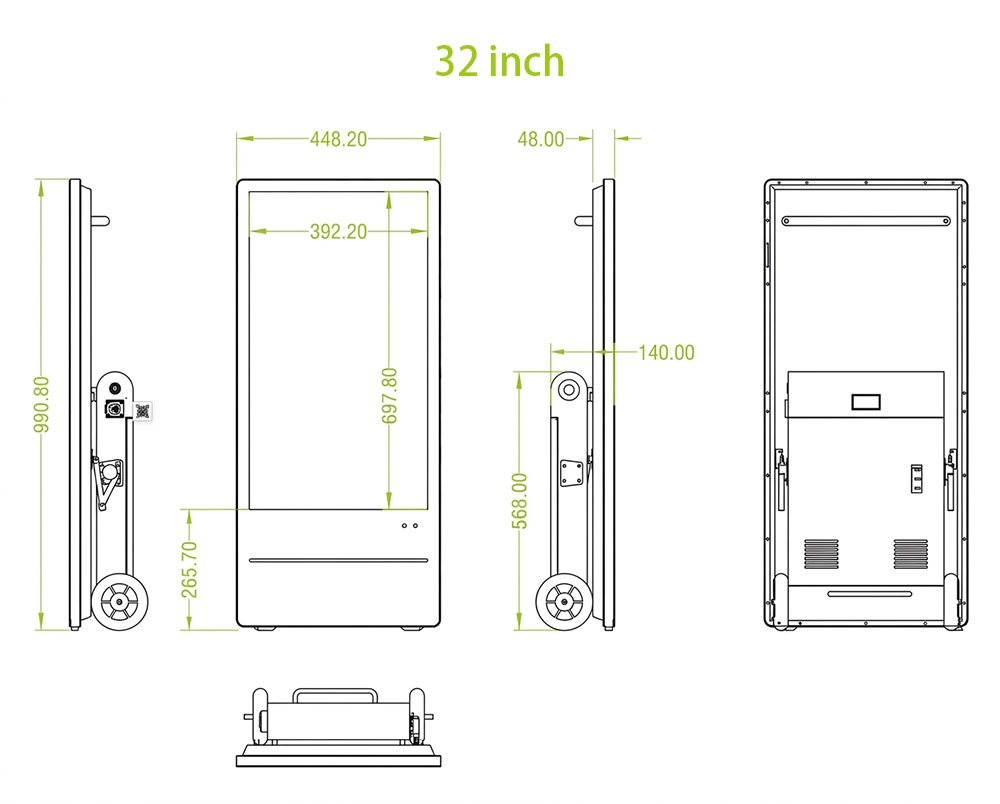
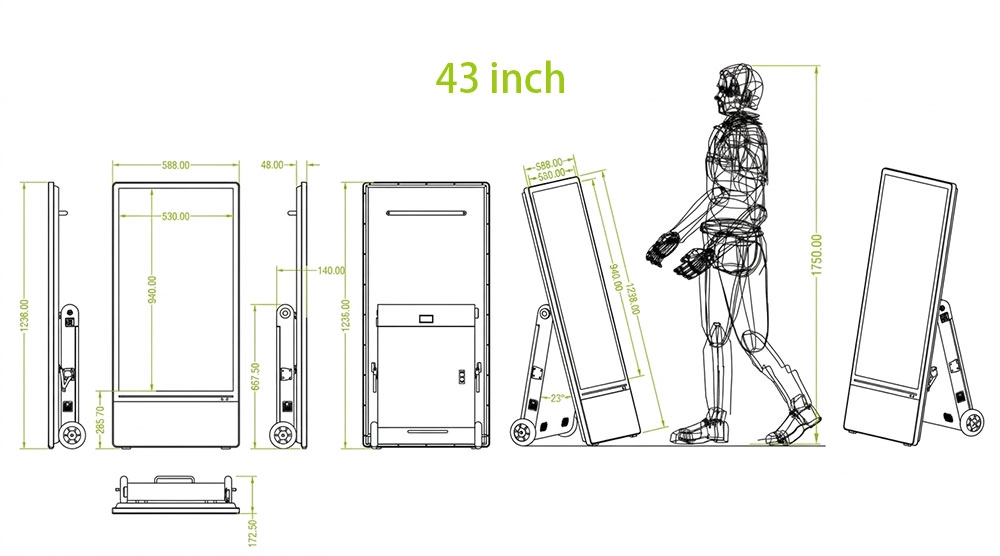
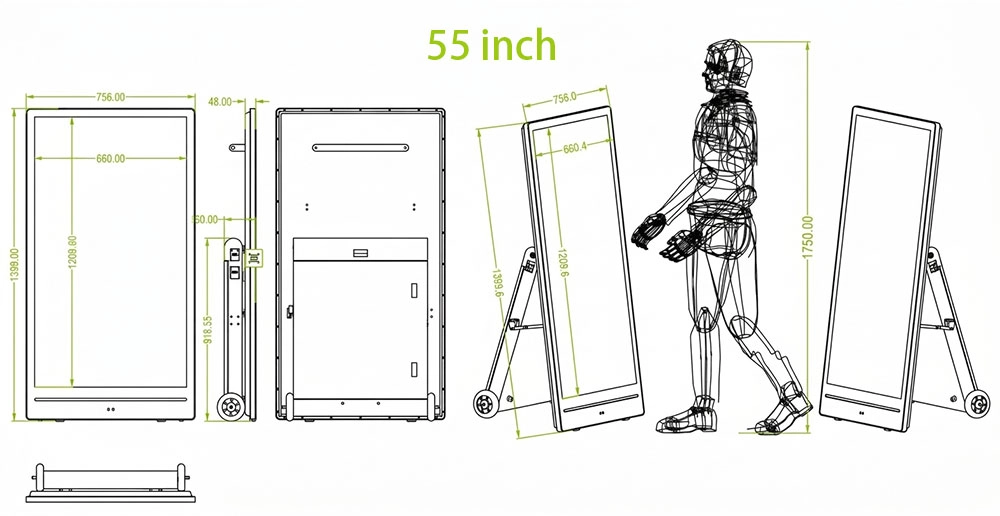
Plan on roughly 3 m / 10 ft of reading distance per 25 mm / 1 in of capital letter height. In practice the 32 and 43-inch models serve readers out to about 10 m / 33 ft and the 55-inch out to about 20 m / 66 ft, which covers a pavement audience, a crossing and a slow-moving vehicle approach. For faster traffic and longer distances a larger fixed-format unit is the right specification.
Yes, within its reading distance. Panels are rated 1,800 cd/m2 on the 32 and 43-inch models and 2,000 cd/m2 on the 55-inch, with 3,500:1 contrast and anti-reflective tempered glass. Brightness alone does not guarantee legibility though - solar aspect and the viewing angle both matter, which is why placement should be checked on site before ordering.
No. The 14-hour battery runs a full operating day and recharges in 7 hours from a standard socket, so the unit needs no supply point and no cable across the footway. Sites that never move can run from mains with the battery as backup, but any cable crossing public ground needs protection and its own approval.
The cabinet is IP65 - dust-tight and protected against rain jets - in galvanized steel with an outdoor powder coating, with an operating range of -50 C to 110 C. Overnight standing is within design intent; flooding and severe storms are not, so bring the unit in for those. Keyed locks keep the battery and player compartment secure when it does stay out.
It is designed not to. The panel dims automatically after dark through its ambient light sensor, content runs in scheduled loops rather than flashing sequences, and placement rules already keep roadside advertising out of junction sight lines. In many jurisdictions outdoor advertising is regulated on exactly these grounds, so it is worth confirming the local rules before a road-facing installation.
Choose by reading distance first. A 32-inch unit suits a doorway or a corner where people read within a few metres; a 43-inch handles a crossing; the 55-inch is the one that carries to a forecourt approach or across a wide street, at the cost of 65 kg and a larger kerbside footprint.
Content is managed through the cloud CMS: playlists are built once, scheduled per unit and per daypart, and pushed over Wi-Fi or the optional 4G module. Sites without connectivity use USB plug-and-play, and firmware updates arrive over the air so a deployed fleet stays current.
Manufacturing is certified to ISO9001, 3C, FCC and UL. The unit carries two years of warranty with lifetime technical support, and replacement parts including batteries, castors and struts remain available for 5+ years after purchase.
Curbside digital signage is decided by permission and sightline before it is decided by design. The sequence below is the one that avoids both the removed board and the unreadable one.
Two of these steps are negotiable and two are not. The audience, the sightline, the permission and the route all have to be settled first; the angle and the content can be tuned afterwards, on site, with the panel switched on. Getting that order right is most of what separates a curbside unit that earns its keep from one that stands in the wrong place looking expensive.
Once the spot is agreed, three physical adjustments decide how much of the investment the audience actually sees.
Height. The screen centre wants to sit close to the eye line of the audience being served - roughly 1.4 to 1.6 m for pedestrians, and comfortably above the bonnet line of passing vehicles where the reader is a driver. Too low and the message is lost behind passing bodies; too high and a vertical panel is being read from below, which flattens the image.
Angle. Very few real spots are read head-on. Aiming the panel slightly toward the dominant approach direction - rather than square to the street - increases the time the message stays in view, and it is the cheapest legibility improvement available on any deployment. The screen tilts on gas-spring struts, so the angle can be set on site without tools.
Obstruction. Then walk the approach both ways and look for what will grow, park or arrive between reader and panel: planting, delivery vans, other advertising boards, seasonal displays. A sightline that is clear in the supplier’s photograph is not evidence about a Tuesday morning on the real street.
Set these three and the same hardware behaves like a different product. Ignore them and a perfectly specified screen becomes street furniture with a bright face and no audience.
Delivering Sunlight-Readable, All-Weather Digital Signage to Global Brands
Established in 2014, Shenzhen Lumi Link Technology Co., Ltd. is a modern high-tech manufacturer focusing on intelligent display equipment. We specialize in professional consoles, digital outdoor advertising screens, and integrated command center solutions for a global client base.
Our core product line covers High-Brightness Outdoor LCD Displays for DOOH advertising, Sunlight-Readable Window Displays for retail storefronts, and durable Outdoor Digital Signage Totems for transit and smart city projects. We also offer bespoke Double-Sided Advertising Screens that maximize visibility from both directions of pedestrian flow.
With ISO 9001 certification and a dedicated R&D team, we provide full OEM/ODM services. From IP65 weatherproof enclosures for coastal cities to 5,000-nit panels for equatorial markets, our digital outdoor advertising screens are exported globally to over 50 countries.
10+ years of industrial experience
1000+ successful project cases
Shipping to 50+ countries and regions
200+ Achievement customers
20+ Technical patents
5000sqm production base

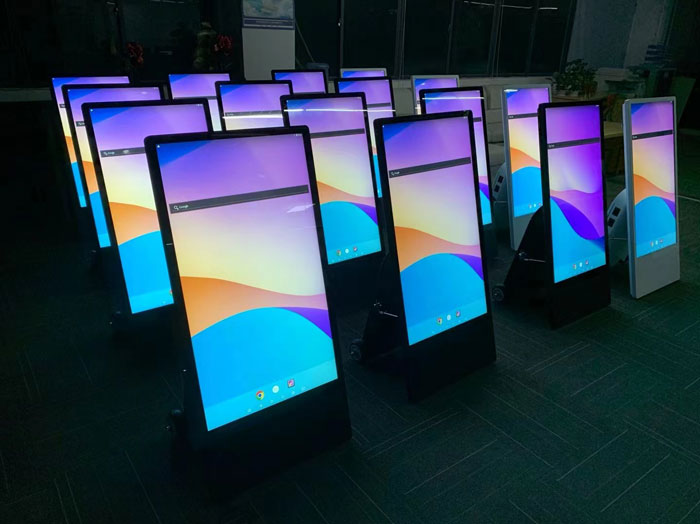
Content designed for a website or an indoor screen fails at the kerbside, and it fails in a specific way: the reader runs out of time before the message runs out of detail.
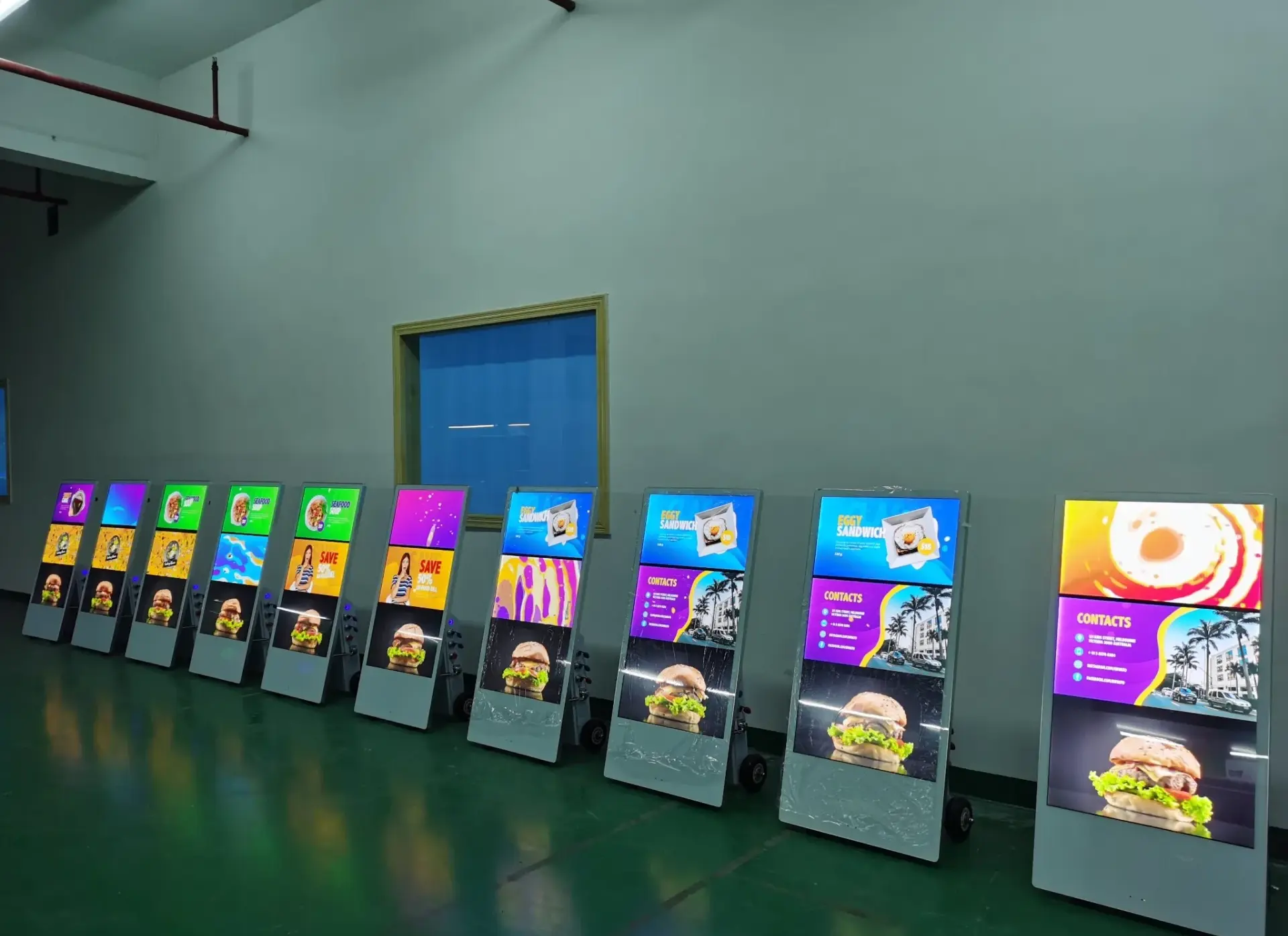
One idea per slide. At walking pace, three seconds is generous; from a vehicle it is closer to two. That is enough for a headline and a logo, and not enough for a paragraph, a price list or a QR code that requires stopping. The strongest street-side creative is usually a single phrase set large against a high-contrast background.
Type sized to the distance. Use the legibility rule as a layout constraint, not an afterthought: choose the cap height for the placement, then build the slide inside it. Portrait format helps here, because it stacks a headline, a supporting line and an arrow without crowding the frame.
Loop length over slide count. A short loop repeated many times outperforms a long playlist seen once. Three or four slides on a fifteen-second rotation are seen several times by a waiting pedestrian and at least once by a passing driver - which is the whole point of a roadside location.
Daypart the message. Breakfast traffic, lunch trade and evening footfall are three different audiences on the same corner. Scheduling by time band costs nothing once the CMS is in place, and it is the single easiest way to make one screen serve a street that changes character through the day.
The kerb is an awkward place to run curbside digital signage, and the two practical constraints are power and reach.
Battery removes the hard problem. A 14-hour pack and a 7-hour recharge mean the unit is self-sufficient for a trading day and refuels overnight indoors. Nothing is trenched, no supply is certified for public ground, and the placement decision stops being a permissions argument about cables. For markets, forecourts and event pitches this is the only practical configuration, and it is the approach the wider battery powered digital signage range standardises on.
Connectivity is optional by design. Where Wi-Fi reaches, content updates arrive from the dashboard. Where it does not - a rural forecourt, a pop-up site - the playlist travels on a USB stick and the player syncs it without anybody opening a settings menu. An optional 4G module covers the middle case: sites with no fixed broadband but usable mobile coverage.
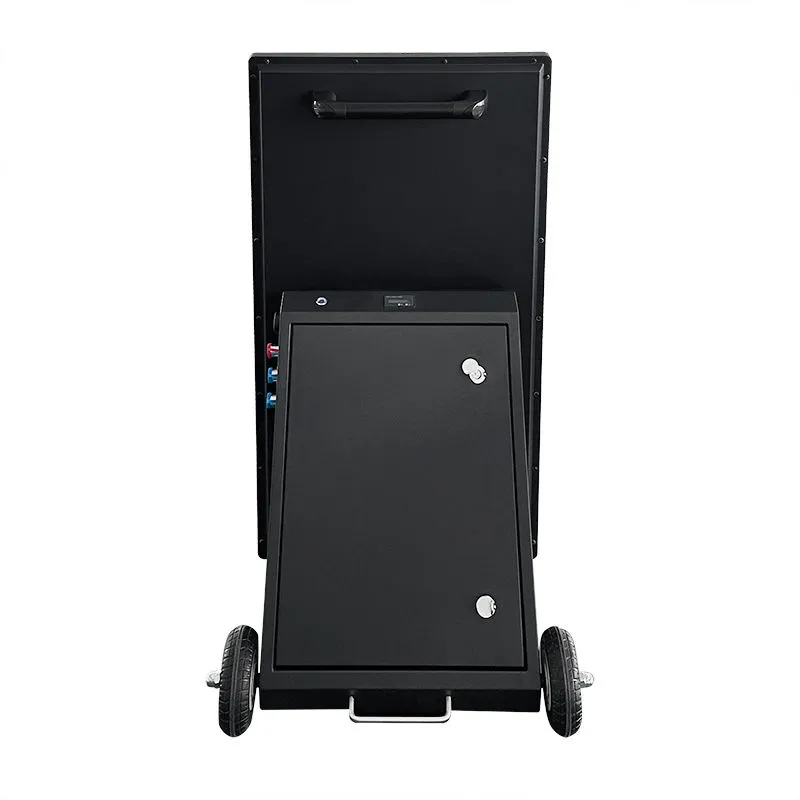
Playlists support 1, 2, 3, 4 and multi-zone layouts, playback covers 30+ video formats and storage expands to 32GB, so a single unit can carry a full season of street creative without anyone visiting the site.
A unit built to stand near traffic has to arrive intact and stay serviceable, so packaging and spares are specified with the hardware.
Export-grade packing. Units ship in a foam-lined carton sized to the folded posture with the battery documented for air and sea freight. Standard cabinet colours are silver, grey, white, black and red; custom colours and branded graphics are available for chain and franchise rollouts.
Factory-direct supply. Lumi Link manufactures in-house under ISO9001 with 3C, FCC and UL certification, and supports both single evaluation units and container programmes. Colour, branding, packaging artwork and firmware defaults are all specified at order stage.
Support after the sale. Two years of warranty on the full unit, lifetime technical support with 24-hour weekday response, and spare parts available for 5+ years - including batteries, castors and struts as individual modules. For first deployments the team reviews the placement plan, the reading distance and the content sizing before the units ship.
Our excellent sales and technical team help your business find the best Rol rate